
Lean has become one of those words that appears everywhere:
- On posters in meeting rooms,
- In vendor presentations,
- In training decks and LinkedIn posts.
But if you walk through many furniture and woodworking factories in India, you see a very different reality from those presentations:
- 5S charts on the wall, but tools still hard to find.
- Kanban boards set up, but no one really follows them.
- Value stream maps made once, then never updated.
On the surface, it looks like “we are doing Lean.”
Underneath, flow is still poor, WIP is still high, and delivery promises are still unstable.
The root problem is not that Lean is wrong.
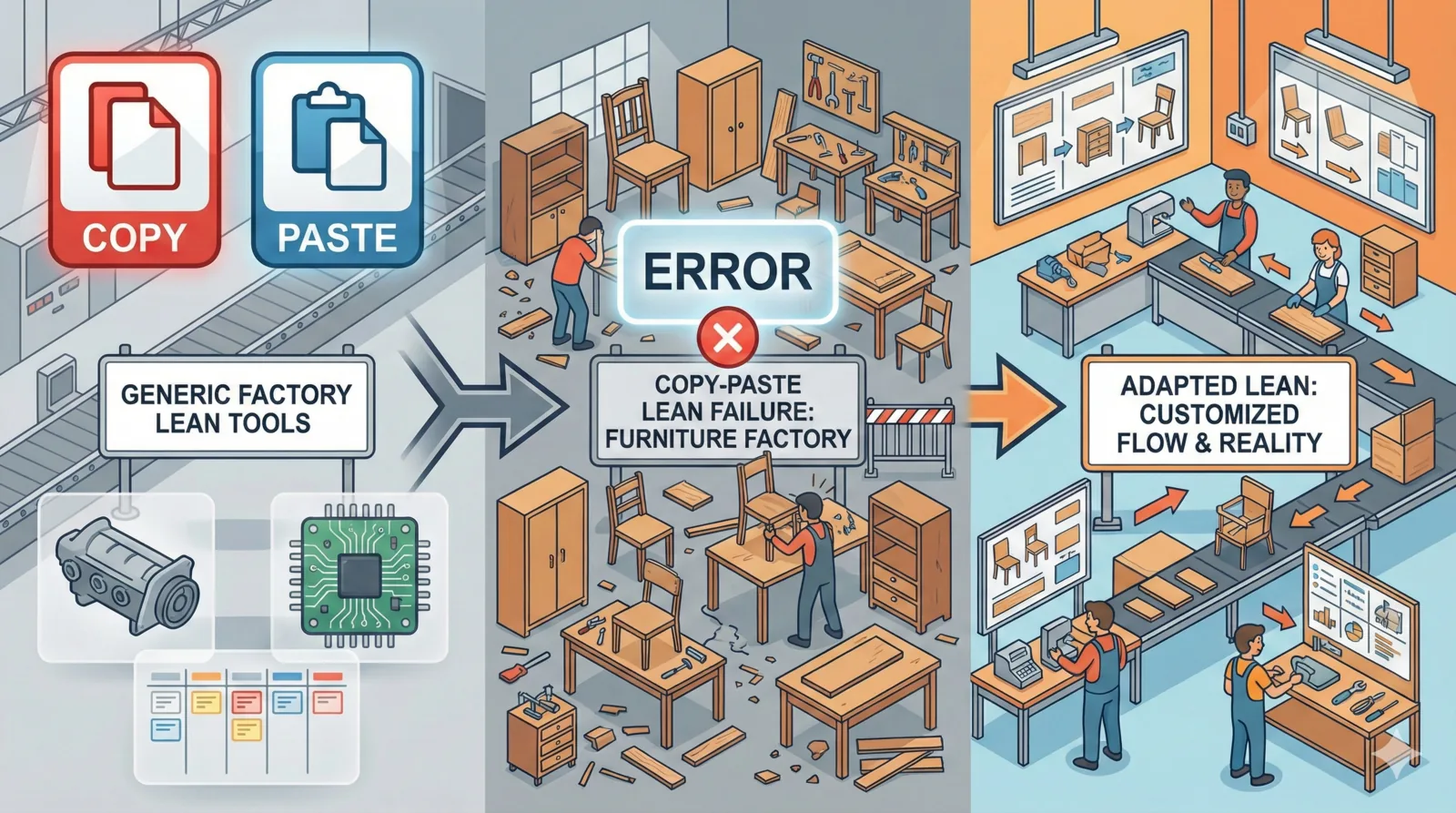
The problem is copy-paste Lean.
Copy-paste Lean = importing tools from somewhere else without understanding your own context.
In this article, I’ll break down why copy-paste Lean fails in furniture factories, and what real Lean looks like when it’s adapted to your products, layouts, and people.
Lean Is Not a Cost-Cutting Programme
One of the first places Lean goes wrong is how it’s positioned.
Too often, Lean is introduced like this:
“We’re starting Lean to reduce cost and reduce people.”
People hear “Lean = less people” and the damage starts immediately:
- Operators become defensive.
- Supervisors hide problems instead of surfacing them.
- Everyone assumes “improvement” means “someone will lose their job.”
But Lean was never about headcount reduction.
Originally, Lean was about:
- Creating flow from one end of the factory to the other.
- Making waste visible so it can be removed.
- Building a system where problems surface quickly and are fixed at the root.
Cost reduction is a result, not the goal.
In furniture factories, the biggest wastes are usually not salaries. They are:
- Material searching and double handling,
- Waiting for decisions or drawings,
- Unbalanced stations where some people are overloaded and others wait,
- Piles of half-finished wardrobes or kitchens stuck in the middle.
If your Lean programme focuses on cutting people instead of fixing these, you are attacking the smallest lever and ignoring the biggest ones.
Copy-Paste Lean: Tools Without Context
This is the core mistake: trying to import Lean instead of designing Lean.
It usually looks like this:
- Someone visits an automotive plant or a large electronics factory.
- They see 5S audits, kanban cards, or a very structured daily meeting.
- They say, “This is outstanding, we should apply the same here.”
So the same tools are copied into a furniture factory that has:
- High product variety,
- Fluctuating demand,
- Short series or even one-off jobs,
- Shared machines across many product families.
At first, everything looks great:
- Racks are labelled,
- Yellow lines are painted,
- Boards go up near each work area.
But within a few weeks:
- Boards are not updated,
- Lines are ignored,
- 5S audits become a formality,
- People joke, “We clean for the audit, then we work like normal.”
Why does this happen?
Because the tools were not designed for the way this factory actually works.
- A kanban system designed for stable, repetitive automotive parts will not survive in a high-mix, low-volume furniture plant without adaptation.
- A daily huddle format copied from another company will not work if your real pain is unclear priorities from sales.
- A 5S checklist that does not consider your real changeover patterns and fixture needs will always feel like “extra work.”
Lean tools are not magic by themselves.
They only work when they are rooted in your flow, your mix, your constraints.
The Cycle-Time Trap: Speed Without Flow
Another common Lean misunderstanding in furniture factories:
“If we reduce cycle time at each machine, we will be Lean.”
So projects are launched to:
- Reduce CNC cycle time by a few seconds,
- Speed up edge bander feeds,
- Minimise drilling machine programmes.
The intention is good. But in a real factory, this can easily happen:
- The “faster” upstream machine creates more WIP waiting at the next stage,
- Operators downstream are overloaded and quality starts dropping,
- Assembly gets flooded with components that don’t have matching parts yet,
- Floor space disappears under trolleys and racks.
The line is faster in places, but the system is more unstable.
Lean is not “make each station as fast as possible.”
Lean is:
Make the flow as smooth and balanced as possible, at the pace the customer actually needs.
In a furniture factory, a line running at calm, balanced speed with low WIP will always beat a line with one “hero” machine and chaos everywhere else.
Ignoring the Human Element
Copy-paste Lean is usually management-heavy and operator-light.
You hear a lot of slogans:
- “Zero waste,”
- “Do it right the first time,”
- “We must be world class.”
You see a lot of posters, trainings, and presentations.
But when you talk to the people who actually work on the machines, you hear:
- “We were not asked how this should work.”
- “The board is nice, but it doesn’t solve my real problem.”
- “We don’t know what to do when the plan is wrong.”
The reality is simple:
Operators and line leaders usually know exactly where the waste is — they just lack a structure and permission to fix it.
When Lean is applied to people instead of with people:
- It feels like an extra burden: more forms, more audits, more reports.
- It doesn’t touch the daily irritations that make work harder.
- It quietly dies as soon as the initial attention fades.
True Lean in furniture factories means:
- Asking operators where they lose time in every shift,
- Co-designing small layout or tool changes with them,
- Giving them simple ways to flag abnormalities (defects, missing parts, unclear drawings),
- Respecting their ideas and implementing at least some of them visibly.
If Lean doesn’t make their life easier, it will never last.
Lean Without Discipline: Projects That Fade Away
Even when factories start with energy—5S drives, kaizen events, layout changes—the momentum often disappears in a few months.
You can recognise this pattern:
- The first 4–6 weeks feel intense and positive,
- There are lots of photos, presentations, and visits,
- Then the steering meetings get postponed,
- Standards slowly slip,
- Old habits return.
Why?
Because Lean was treated as a project, not a discipline.
Projects have:
- Kickoff meetings,
- Deadlines,
- PowerPoint decks.
Disciplines have:
- Daily and weekly routines,
- Clear ownership,
- Boring consistency.
World-class factories are not “always launching something new.”
They are quietly doing the right small things every day:
- Short daily huddles that actually drive action,
- Simple standards that are actually followed,
- Visual controls that are actually used to make decisions,
- Leaders who visit the shopfloor and ask real questions, not just tick boxes.
Copy-paste Lean focuses on activities.
Real Lean focuses on behaviour.
What Lean Really Looks Like in Furniture Factories
When Lean is adapted instead of copied, furniture factories start to look and feel very different.
Some patterns you will see on the shopfloor:
- Materials move mostly forward, not zig-zagging back and forth between machines.
- Product families (for example, wardrobes vs. kitchens) have defined routes.
- Workloads are balanced so one station is not constantly drowning while another is idle.
- Visual management is simple and specific:
- Priority jobs marked clearly on trolleys,
- Clear limits on how much WIP is allowed in each area,
- Status boards that any visitor can understand in 30 seconds.
- Operators are trained to:
- Stop when something is wrong instead of pushing it forward,
- Raise problems without fear,
- Suggest small improvements in layout, fixtures, and instructions.
- Improvements are:
- Small and continuous,
- Tested on one line or one family first,
- Adjusted based on actual experience.
This is not Lean as a label.
This is Lean as a working system.
You can see these patterns repeatedly in real improvement work across factories, including many of the line optimisation stories described on my resume page.
How to Avoid Copy-Paste Lean in Your Factory
So, if copying from other industries doesn’t work, what should you do instead?
Here is a practical approach you can use in a real furniture or woodworking factory, without huge budgets or endless workshops.
1. Start with your value stream, not somebody else’s template
Pick one major product family, for example:
- Built-in wardrobes,
- Modular kitchens,
- Office workstations.
Then:
- Map the real steps from order to dispatch, including design and approvals.
- Mark where material waits, where decisions get stuck, and where defects often appear.
- Identify which step truly controls the pace today (your current bottleneck).
This is your context. Lean has to be built on this, not on a generic diagram.
2. Define the real problems in plain language
Instead of saying:
“We want to implement Lean.”
Say things like:
- “Too much time is lost searching for material and hardware.”
- “Assembly waits for matching parts in almost every order.”
- “Supervisors spend hours each day just finding where jobs are.”
- “We don’t trust the dates we promise to customers.”
Now you know what Lean has to solve. Tools come later.
3. Choose tools to fit problems, not the other way round
Some examples:
- If material is hard to find → start with simple location standards, labelled racks, and basic 5S focused on that problem only.
- If priorities are unclear → introduce a visual planning board or simple digital display for today’s plan, not a full MES on day one.
- If assembly is always waiting → experiment with small supermarkets of ready sub-assemblies and clearer upstream signals.
Take one or two tools. Adapt them.
Test them on one area before painting the whole factory in their colours.
4. Co-design with the people who will use it
For each change:
- Sit with operators and team leaders in that area,
- Listen to how they work today,
- Ask what would genuinely make their day easier,
- Sketch solutions together on paper or the floor,
- Prototype with tape, cardboard, and temporary signs before fixing anything permanently.
When people help design the new standard, they are far more likely to defend it when pressure comes.
5. Build routines, not campaigns
For every Lean element you introduce, also define:
- Who checks it,
- How often,
- What they do if they find a problem.
Examples:
- A 10-minute start-of-shift check in cutting,
- A short daily flow meeting for one value stream,
- A weekly walk specifically to review WIP levels and blocked orders.
Keep it light but consistent. Lean dies when routines are too heavy and unrealistic; it thrives when they are small and sustainable.
When External Inspiration Is Useful
None of this means you should never look outside.
Visits, books, and case studies are very valuable when used correctly:
- Use them to expand your imagination about what is possible.
- Use them to learn principles, not copy detailed tools.
- Ask: “Why does this work there? Which of those conditions do we have, and which do we not?”
For example:
- Automotive shows what is possible with takt and stability.
- Electronics shows what is possible in high-volume, precise assembly.
- Furniture factories in other regions might show layouts tuned for specific product mixes.
Your job is not to become a copy.
Your job is to build a Lean system that fits your space, your machines, your people, and your customers.
Final Thoughts: Stop Copying, Start Adapting
Lean fails in many furniture factories not because the concept is flawed, but because it is:
- Copied without context,
- Launched as a cost-cutting exercise,
- Applied to people instead of with them,
- Treated as a project instead of a daily discipline.
If you shift your mindset from “Which Lean tools should we copy?” to:
“How can we make waste visible, improve flow, and involve our people in solving real problems in our factory?”
…then Lean stops being a buzzword and starts becoming a competitive advantage.
Copy-paste Lean gives you posters and PowerPoints.
Adapted Lean gives you calmer flow, more reliable delivery, and a factory that actually feels better to work in.
And that difference will never come from a template. It can only come from the work you do in your own reality.
Comments (0)
Loading comments...
Leave a Comment