
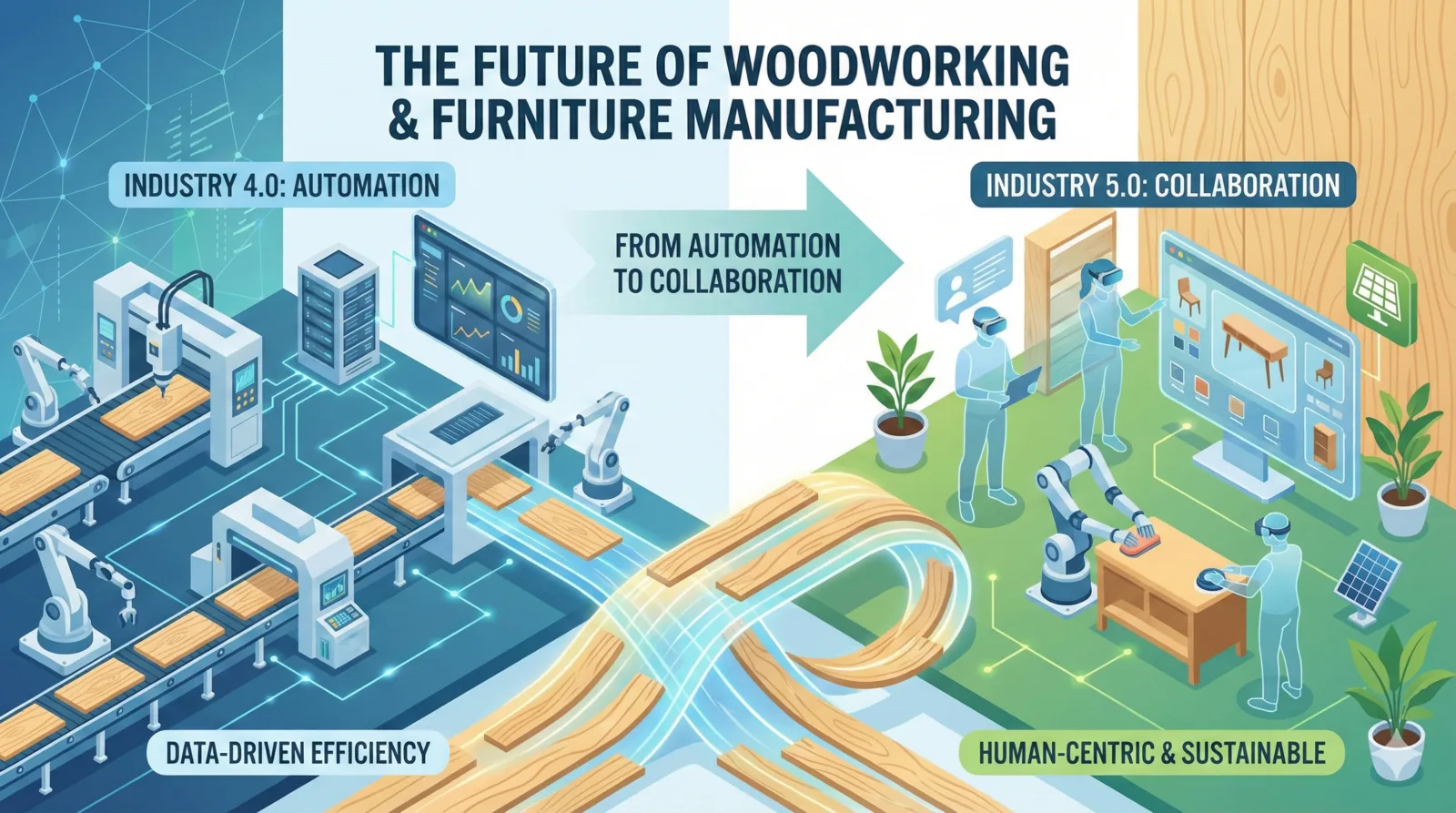
For years, “automation” has been the magic word in woodworking and furniture manufacturing. More CNCs, more software, more dashboards.
But as factories in India and across the world move deeper into Industry 4.0 and start touching Industry 5.0, something important is becoming clear:
It’s not just about replacing people with machines. It’s about getting people and machines to work together in a smarter, more human-centric way.
In other words, the real shift is from automation to collaboration.
Factories that understand this are already seeing better productivity, more flexible production, and happier teams. The ones that don’t often end up with expensive tech that no one really uses well.
In this article, we’ll look at what Industry 4.0 and 5.0 really mean for woodworking and furniture manufacturers, especially in India, and how to move towards a future where technology amplifies human capability instead of fighting it.
What Industry 4.0 Really Looks Like on a Woodshop Floor
Industry 4.0 is essentially about making factories connected, data-driven, and responsive. On a woodworking or furniture shop floor, it shows up in very practical ways.
Cyber-physical systems (CPS)
Instead of machines running in isolation, you have:
- Machines that send real-time data about speed, downtime, tool wear, or energy use.
- A digital layer that can “see” what is happening and help supervisors decide what to do.
- Programs and parameters that can be updated centrally instead of manually at each machine.
A CNC router or edge bander is no longer just a machine – it becomes part of a living, connected system.
Internet of Things (IoT) on the shop floor
IoT devices link machines, sensors, and even simple manual stations:
- Vibration and temperature sensors on spindles and motors.
- Energy meters on dust collectors and compressors.
- Simple counters on drilling or assembly stations.
All of this feeds into dashboards or basic reports that show:
- Where the line is slowing down.
- Which machines are over-utilised or under-utilised.
- When a breakdown is likely if you don’t maintain a part.
Even in small and mid-sized factories around Bangalore, Delhi-NCR, or Pune, you don’t need a huge budget to start. Often, one or two well-chosen IoT applications can give you more insight than ten generic reports.
Big data and analytics (without the buzzwords)
Most woodworking factories already have data – but usually in scattered forms:
- Production reports in Excel.
- Quality logs in paper registers.
- Machine data that no one downloads.
- ERP entries that no one fully trusts.
Industry 4.0 thinking pushes you to:
- Decide which data actually matters for throughput, quality, and delivery.
- Clean it up enough to trust it.
- Use simple analysis to answer real questions:
“Where are we losing most time?”
“Which product families cause the most rework?”
“Which shift actually runs the line better?”
You don’t have to start with AI. You start with consistent data and honest questions.
Additive manufacturing and rapid prototyping
For woodworking and furniture, additive manufacturing is not about printing a full wardrobe. It’s more about:
- Quickly creating jigs, fixtures, or connectors.
- Prototyping hardware components.
- Testing complex shapes before committing to full tooling.
This can significantly shorten the time between design idea and physical sample, which is critical in markets like India where customer preferences change fast.
Industry 5.0: Bringing People Back to the Centre
If Industry 4.0 is about highly automated, connected factories, Industry 5.0 asks a deeper question:
How do we use all this technology to create better work for people and better outcomes for customers and society?
For woodworking and furniture manufacturing, that means three big shifts.
Human–machine collaboration, not replacement
Industry 5.0 is where skilled operators and engineers work alongside smart machines and cobots, not against them.
Examples on a furniture shop floor:
- A cobot handling heavy panels at a CNC, while an operator focuses on quality and program adjustments.
- Augmented reality (AR) work instructions guiding assemblers, while experienced supervisors tweak processes based on real-world constraints.
- Operators using tablets to give feedback on programs, tool paths, or fixture design – feeding improvements back into engineering.
The goal is not “lights-out” factories, but factories where human judgment and creativity are multiplied by technology.
Customisation without chaos
Customers increasingly expect:
- Custom sizes.
- Unique finishes.
- Modular designs that still feel personalised.
Industry 5.0 encourages mass customisation – the ability to deliver individualised products without losing control of cost and lead time.
For Indian furniture manufacturers, this could mean:
- Configurable design libraries instead of completely one-off designs.
- Parameter-driven programs that adjust automatically when dimensions change.
- Clear rules for what can and cannot be customised, so sales doesn’t promise what production cannot deliver.
Sustainability and responsibility
Woodworking and furniture manufacturing are close to natural resources – timber, panels, adhesives, finishes. Industry 5.0 puts more focus on:
- Reducing off-cuts and rework through better nesting and process stability.
- Switching to lower-VOC finishes and more efficient curing systems.
- Measuring energy use per job, not just overall bills.
- Designing products for longer life and easier repair.
This isn’t just about compliance. For many brands, especially export-oriented ones, sustainability is already a commercial requirement.
Industry 4.0 + 5.0: Stronger Together, Not Competing Ideas
It’s easy to think of these as two separate “phases”, but in reality, woodworking factories will often live in both worlds at the same time.
Here’s how they reinforce each other:
Automation + human judgment
- Industry 4.0 gives you automated lines, connected machines, and data.
- Industry 5.0 ensures operators, planners, and engineers can shape how the system behaves and make better day-to-day decisions.
Efficiency + flexibility
- 4.0 pushes for higher throughput and less waste.
- 5.0 adds the ability to adapt quickly to new designs, rush orders, or special finishes without losing control.
Data + meaning
- 4.0 provides the numbers: cycle times, OEE, rejection rates.
- 5.0 uses those numbers to ask: “What’s worth improving? How does this affect people and customers?”
Technology + trust
- 4.0 can feel like something “done” to people on the shop floor.
- 5.0 brings them into the conversation, turning them into partners instead of passive users.
The factories that thrive will be the ones that treat these as complementary lenses, not as separate checklists.
A Practical Roadmap for Woodworking Factories in India
Many factories in India feel stuck between “we should do something with Industry 4.0” and “we don’t want to waste money on the wrong thing”.
Here’s a simple, practical roadmap to move from automation to collaboration.
1. Start with one value stream, not the whole factory
Pick a product family or line, for example:
- Kitchen carcasses,
- Bedroom wardrobes,
- Office workstations.
Map the flow from order to dispatch:
- Where does information get stuck?
- Where does material wait?
- Where do decisions depend on one or two people?
This gives you a clear picture of where Industry 4.0 tools and Industry 5.0 collaboration can help most.
2. Connect a few key machines and stations
Instead of trying to connect everything at once:
- Choose 2–3 machines that matter most in the chosen value stream.
- Add IoT sensors or use existing data interfaces.
- Track simple, meaningful metrics: uptime, changeover time, first-time-right quality.
Share this data with the operators and supervisors, not just management. Ask them:
- “Does this reflect your reality?”
- “What would make your work easier if we could measure it?”
Now you’ve started building a shared view of reality, which is the foundation of Industry 5.0. These are patterns I see repeatedly in the line optimisation projects I’ve been involved in.
3. Introduce collaboration tools, not just dashboards
A lot of factories invest in dashboards that only a few people in the office look at. Instead, think about:
- Simple Andon-style alerts that show when help is needed.
- Digital checklists for start-up, changeover, and maintenance.
- Comment or feedback loops where shop-floor teams can flag issues and suggestions.
The point is to use technology to improve conversations, not just generate more reports.
4. Pilot one human–machine collaboration use case
Pick a small but visible pilot where people and machines clearly work together better:
- A cobot assisting in sanding or loading heavy panels.
- Vision systems helping quality inspectors look for common defects.
- Digital work instructions that reduce training time for new operators.
Involve the people who will use it from day one:
- Let them test different layouts and sequences.
- Ask what feels natural or unnatural.
- Share early results openly – both good and bad.
If done well, this pilot becomes a story of success you can replicate in other parts of the factory.
5. Build skills alongside technology
Industry 4.0 often fails not because the tech is bad, but because people are never given the chance to grow with it.
Plan parallel tracks:
- Technical training: CNC programming, basic data analysis, IoT basics.
- Problem-solving skills: root cause analysis, SMED, flow thinking.
- Soft skills: how engineers, planners, and operators collaborate.
In many projects I’ve seen, the biggest performance jump came not from the newest sensor, but from better cross-functional teamwork – something reflected in the work on my resume page.
Common Pitfalls to Avoid
As factories in India and elsewhere move toward Industry 4.0 and 5.0, some traps show up again and again.
Buying technology before defining the problem
It’s tempting to start with:
- “We need an Industry 4.0 solution.”
- “We should get a smart factory platform.”
A better way is to start with questions like:
- “Where are we losing the most time or margin today?”
- “What kind of decision do we consistently make too late?”
- “Which part of the flow is most unpredictable?”
Only then choose technologies that directly help with those questions.
Creating islands of automation
You may already have:
- A very advanced CNC cell.
- A fully automated panel saw.
- A modern paint line.
If they are not well connected to planning, material flow, and downstream stations, they become islands of excellence in a sea of chaos.
Industry 4.0 and 5.0 push you to think about end-to-end flow, not just individual machines.
Ignoring people’s fears and ideas
When new technology arrives, people on the shop floor often wonder:
- “Will this make my job irrelevant?”
- “Will my experience still matter?”
- “Will I be blamed if something goes wrong?”
If you don’t address these questions, you get quiet resistance:
- Systems are “used” but not really adopted.
- Data is entered just to tick a box.
- Problems go underground instead of being surfaced.
Good Industry 5.0 practice means treating operators and supervisors as co-designers of the new way of working, not just end-users.
The Future of Woodworking and Furniture Manufacturing Is Collaborative
Industry 4.0 gave woodworking and furniture factories powerful tools:
- Connected machines,
- Data-driven planning,
- Faster prototyping.
Industry 5.0 adds an equally important layer:
- Human-centric design of work,
- Collaboration between people and machines,
- Responsibility towards sustainability and society.
For factories in India, this combination is especially valuable. You are operating in a market that demands speed, customisation, and cost control, often in buildings and with teams that have evolved over many years.
The way forward is not to chase every new technology trend, nor to reject change and rely only on “how we’ve always done it”.
The way forward is to use technology to amplify the strengths you already have:
- Skilled people,
- Deep process knowledge,
- Flexibility in making varied products.
From automation to collaboration – that is where the real competitive advantage lies for woodworking and furniture manufacturers in the era of Industry 4.0 and 5.0.
Comments (0)
Loading comments...
Leave a Comment