
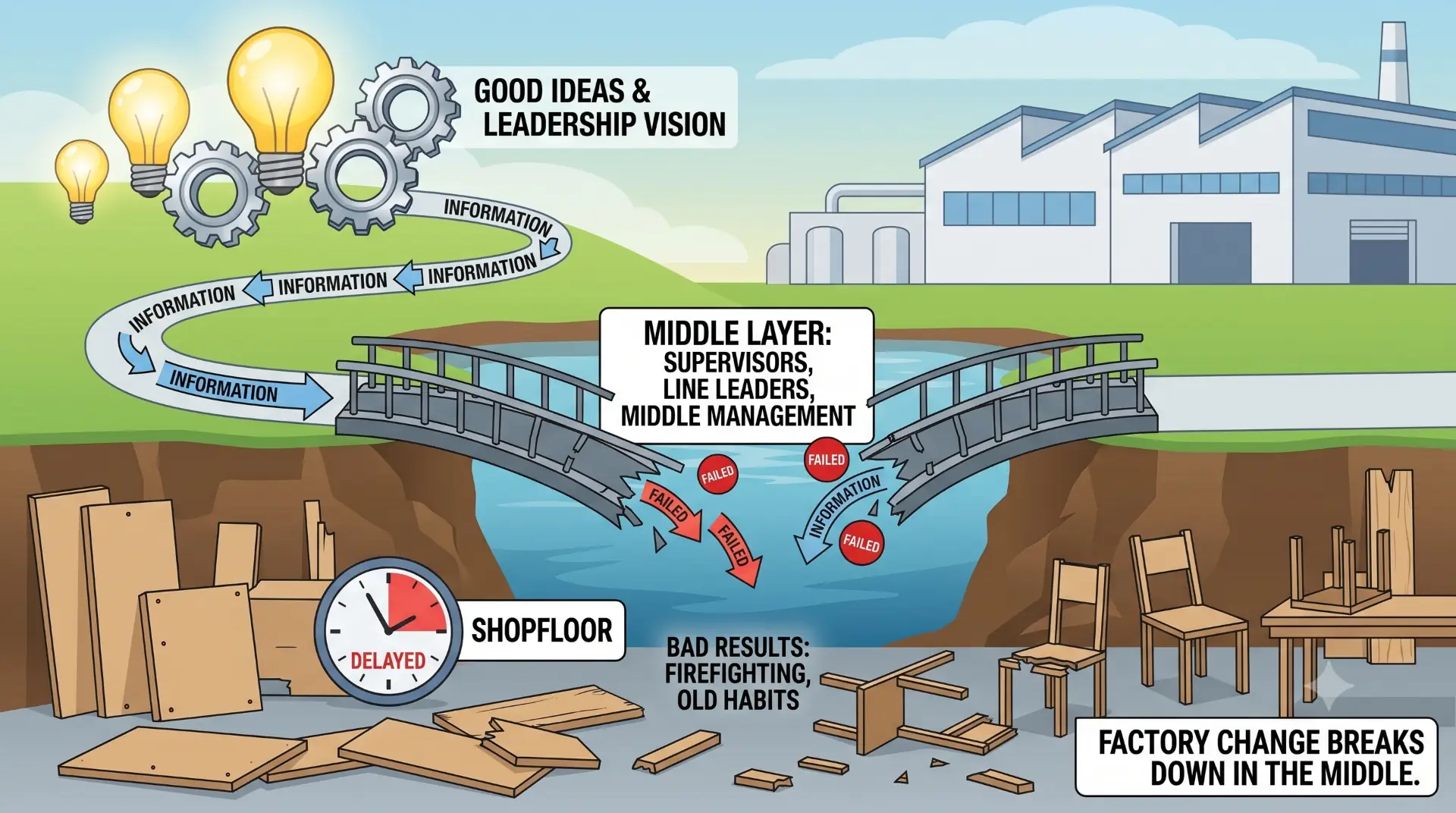
Factories rarely struggle because they lack ideas.
Most factories already know what they should improve:
- Better planning,
- Better material flow,
- Better use of machines,
- Better data,
- Better coordination between departments.
They may even invest in the right things:
- A consultant,
- A new system,
- A new reporting format,
- A Lean initiative,
- Training for teams.
And yet, months later, the results are missing.
The shopfloor still looks familiar. The same firefighting continues. People quietly drift back to old habits.
When this happens, owners and leadership teams often assume one of two things:
“Maybe the idea was not practical.”
or
“Maybe the operators were resistant.”
But in many factories, the real breakdown happens somewhere else.
Factory change usually breaks down in the middle.
Not at the top, where the vision is created.
Not at the bottom, where the work gets done.
But in the middle layer — supervisors, line leaders, production coordinators, and middle managers — where strategy is supposed to become daily behaviour.
That middle layer is where factory change either becomes real or quietly dies.
Why Good Improvement Ideas Still Fail
On paper, most factory improvement projects look sensible.
A typical story goes like this:
- Leadership identifies a recurring problem.
- An improvement plan is launched.
- People attend kickoff meetings.
- The early energy feels positive.
- For a few weeks, everyone talks about the change.
Then the pattern shifts:
- Follow-up becomes inconsistent.
- Daily pressures take over.
- The new system is used only partially.
- Shopfloor reality slowly returns to normal.
Eventually the project becomes one more “initiative” people remember but do not really follow.
This is especially common in woodworking and furniture factories in India, where teams often operate under daily pressure from changing priorities, urgent deliveries, labour variability, and product mix complexity.
In such environments, even a strong improvement idea cannot survive on leadership intent alone.
It needs translation into daily work.
And that translation happens through the middle.
The Middle Layer Is the Real Bridge
Supervisors and middle managers are often underestimated in change discussions.
At the leadership level, the conversation is usually about direction:
- What should improve?
- Which targets matter?
- Which system or method should be introduced?
At the operator level, the conversation is usually about execution:
- What job is next?
- What standard should I follow?
- What problem should I escalate?
But the middle layer handles the difficult space in between:
- Setting daily priorities,
- Interpreting leadership decisions,
- Managing exceptions,
- Balancing output vs. compliance,
- Coaching people through real constraints.
This means middle managers do not just “pass messages down.”
They shape what change actually becomes.
If they are aligned, improvements gain rhythm and credibility.
If they are confused, overloaded, or unconvinced, even a good idea gets diluted before it reaches the floor.
That is why two factories can launch the same improvement program and see completely different outcomes:
- In one, the change becomes part of daily routine.
- In the other, it becomes another poster on the wall.
The difference is often not the quality of the idea.
It is the quality of buy-in and follow-through in the middle layer.
How Factory Change Breaks Down in the Middle
Most middle-layer resistance does not look dramatic.
It rarely appears as open rejection. More often, it shows up as subtle drag.
1. Change is treated as “extra work”
This is one of the most common patterns.
A supervisor is already dealing with:
- Absenteeism,
- Delayed material,
- Urgent orders,
- Machine issues,
- Customer pressure coming from above.
Now a new project arrives:
- Fill this board,
- Track this metric,
- Follow this new review structure,
- Run this new standard.
If the supervisor experiences change as something in addition to their real job, they will naturally protect the immediate work first.
The result:
- Improvement work is postponed,
- New routines are used only when someone is watching,
- Adoption remains shallow.
2. Fear of visibility and transparency
Some improvement systems create more visibility:
- Better production tracking,
- Clearer accountability,
- More accurate capacity reporting,
- More structured escalation.
In theory, this is a good thing.
In practice, it can feel threatening.
Middle managers may worry:
- “Will this expose problems in my area?”
- “Will leadership now see delays I used to manage informally?”
- “If the data becomes transparent, will I lose control?”
This fear is often unspoken, but it matters.
If visibility is introduced without trust and support, people do not experience it as empowerment. They experience it as risk.
And when people feel at risk, they protect themselves before they protect the system.
3. Mixed messages from above and below
Many factories unintentionally create contradiction.
Leadership says:
- “Follow the new process.”
- “Use the new planning system.”
- “No more bypassing standards.”
But when pressure comes, middle managers hear something else in practice:
- “Just dispatch the urgent order somehow.”
- “Do whatever is needed this week.”
- “We’ll follow the new system later.”
So what do they do?
They revert to old coping habits.
Then operators receive two versions of reality:
- The official version from meetings,
- The survival version from daily supervision.
That is when trust begins to disappear.
Operators stop taking the improvement seriously because they can see that the real rules change whenever pressure increases.
4. Comfort with the current workaround system
Many factories do not run on formal systems alone.
They run on:
- Relationships,
- Shortcuts,
- Informal coordination,
- Experience-based workarounds,
- “This is how we manage things here.”
These habits may not be ideal, but they feel safe because they are familiar.
A new improvement project often asks the middle layer to replace familiar control with a more structured system.
That sounds reasonable on paper. In reality, it can feel like giving up something they know how to manage.
So even when people agree intellectually that the new approach is better, they may still default to the old one under stress.
That is not because they are against progress.
It is because habits under pressure always reveal what people truly trust.
Signs That Change Is Breaking Down
Factory change rarely fails all at once.
It leaks energy in visible ways.
Here are some signs you can look for on the floor.
Operators are confused about what really matters
You hear comments like:
- “Management wants one thing, but our supervisor tells us something else.”
- “We updated the system, but then we were told to run the urgent job differently.”
- “We are following the board only when someone comes for review.”
This is one of the clearest warning signs that the middle layer is not fully aligned with the change.
Reports look better than the floor feels
This is common in both manual and digital systems.
On paper:
- Boards are updated,
- Meetings happen,
- KPIs appear under control.
On the floor:
- Priorities are still unstable,
- Searching and firefighting continue,
- Real flow does not feel calmer.
When reporting improves faster than behaviour, the project has become performative rather than transformative.
Momentum fades as soon as leadership attention reduces
In weak transformations, the change survives only while:
- The consultant is present,
- Senior leadership is reviewing closely,
- Audit pressure is high.
The moment that attention drops, old habits return.
This does not mean the idea was bad. It means ownership never moved into the operational core of the factory.
Supervisors comply, but do not champion
This is a subtle but important distinction.
A middle manager may:
- Attend meetings,
- Use the format,
- Repeat the language.
But if they do not actively coach, reinforce, and protect the new way of working, the change stays fragile.
Real transformation needs middle managers who do more than comply.
It needs middle managers who carry the change.
Why Operators Are Usually Not the Main Problem
Many factory leaders assume that resistance sits on the shopfloor.
In reality, operators are often more open to improvement than expected — especially when the improvement genuinely makes work easier.
Operators usually respond positively to changes that reduce:
- Searching,
- Rework,
- Confusion,
- Unnecessary movement,
- Last-minute chaos.
What frustrates them is not change itself.
It is inconsistency.
If one day they are told to follow the new method and the next day told to ignore it for output, they learn an important lesson:
“This change is not real. It is temporary.”
Once that belief forms, adoption becomes very difficult.
That is why sustainable factory change depends less on slogans and more on stable reinforcement through daily supervision.
If the middle layer stays consistent, operators adapt. If the middle layer wavers, operators protect themselves by returning to what feels safe.
How to Get the Middle Layer On Board
If factory change breaks down in the middle, then the obvious question is:
How do you strengthen that layer?
1. Involve supervisors early, not after decisions are finished
Too many improvement projects are designed fully at the top and then handed to supervisors for execution.
This creates predictable reactions:
- “Another plan made without understanding our reality.”
- “This will add work.”
- “Let’s see how long this lasts.”
Instead, involve the middle layer while the design is still being shaped:
- Ask where they expect friction,
- Ask which parts will fail under real pressure,
- Ask what support they would need to make it work.
When supervisors help shape the change, they are far more likely to defend it later.
2. Explain how the change helps them
Leadership often communicates improvement in abstract terms:
- Better discipline,
- Better reporting,
- Better control,
- Better management systems.
But middle managers care about their real daily pain:
- Constant firefighting,
- Conflicting priorities,
- Lack of clarity,
- Pressure without support.
So the message should be practical:
- How will this reduce daily chaos?
- How will this make priorities clearer?
- How will this help them manage exceptions better?
- How will this reduce dependence on memory and informal coordination?
If they can see personal operational relief, buy-in increases sharply.
3. Train them to lead change, not just monitor it
Many supervisors are technically experienced but not always equipped to coach through change.
They may know production well, but struggle with:
- Reinforcing standards,
- Giving structured feedback,
- Handling resistance,
- Escalating issues constructively.
So improvement projects need more than process training.
They need leadership training for the middle layer:
- How to run a short daily review,
- How to correct without creating fear,
- How to solve recurring issues at root cause,
- How to translate management intent into floor-level action.
4. Balance accountability with support
Tracking adoption matters.
But if the middle layer feels only judged and not supported, change becomes defensive.
The better balance is:
- Clear expectations,
- Visible follow-up,
- Practical support,
- Enough time and space to stabilise the routine.
People do not sustain change because they are told it matters. They sustain change because the system around them makes it possible to do so.
What Successful Factories Do Differently
In stronger factories, the middle layer is not treated as a reporting channel.
It is treated as the backbone of execution.
These factories typically do a few things well:
They celebrate operational champions, not only big outcomes
When supervisors reinforce standards, solve problems early, and carry improvements consistently, leadership notices and reinforces it.
That creates a different cultural message:
“Driving change well matters here.”
They create feedback loops upward, not just instructions downward
Operators and supervisors are encouraged to surface what is not working:
- Which standards are unrealistic,
- Which systems create friction,
- Which changes need adjustment.
This prevents the transformation from becoming disconnected from reality.
They make change part of management work, not a side project
Improvement is not treated as something separate from operations.
It becomes part of:
- Daily reviews,
- Weekly problem-solving,
- Capacity discussions,
- Priority setting.
That is when change becomes durable.
Many of these patterns show up repeatedly in the projects and the broader factory transformation themes described on the experience page.
A Simple Test for Your Factory
If you want to test whether your factory change effort is strong or fragile, ask these questions:
- If the consultant stepped away for a month, would the new routine survive?
- If senior leadership stopped reviewing weekly, would supervisors still drive the change?
- Can operators clearly explain the new way of working without contradiction?
- Do middle managers speak about the change as their system or as management’s project?
The answers will tell you a lot.
Because sustainable factory change is not measured by launch quality.
It is measured by what remains when the spotlight moves on.
Final Thoughts: The Bridge Is the System
Factories do not fail because they lack ideas.
They fail because ideas are not converted into consistent daily behaviour.
And that conversion happens in the middle.
Supervisors, line leaders, and middle managers are not just one more organisational layer. They are the bridge between intention and reality.
If that bridge is weak:
- Good ideas turn into weak results.
- Projects fade after the initial excitement.
- Operators lose trust in the next initiative.
But if that bridge is strong:
- Change becomes practical,
- Standards become believable,
- Improvements survive pressure.
So the next time a factory initiative starts with energy and ends with disappointment, do not ask only:
“Was the idea right?”
Also ask:
“Did we equip the middle layer to carry it?”
Because in most factories, that is where change really breaks down — and where lasting improvement really begins.
Comments (0)
Loading comments...
Leave a Comment