
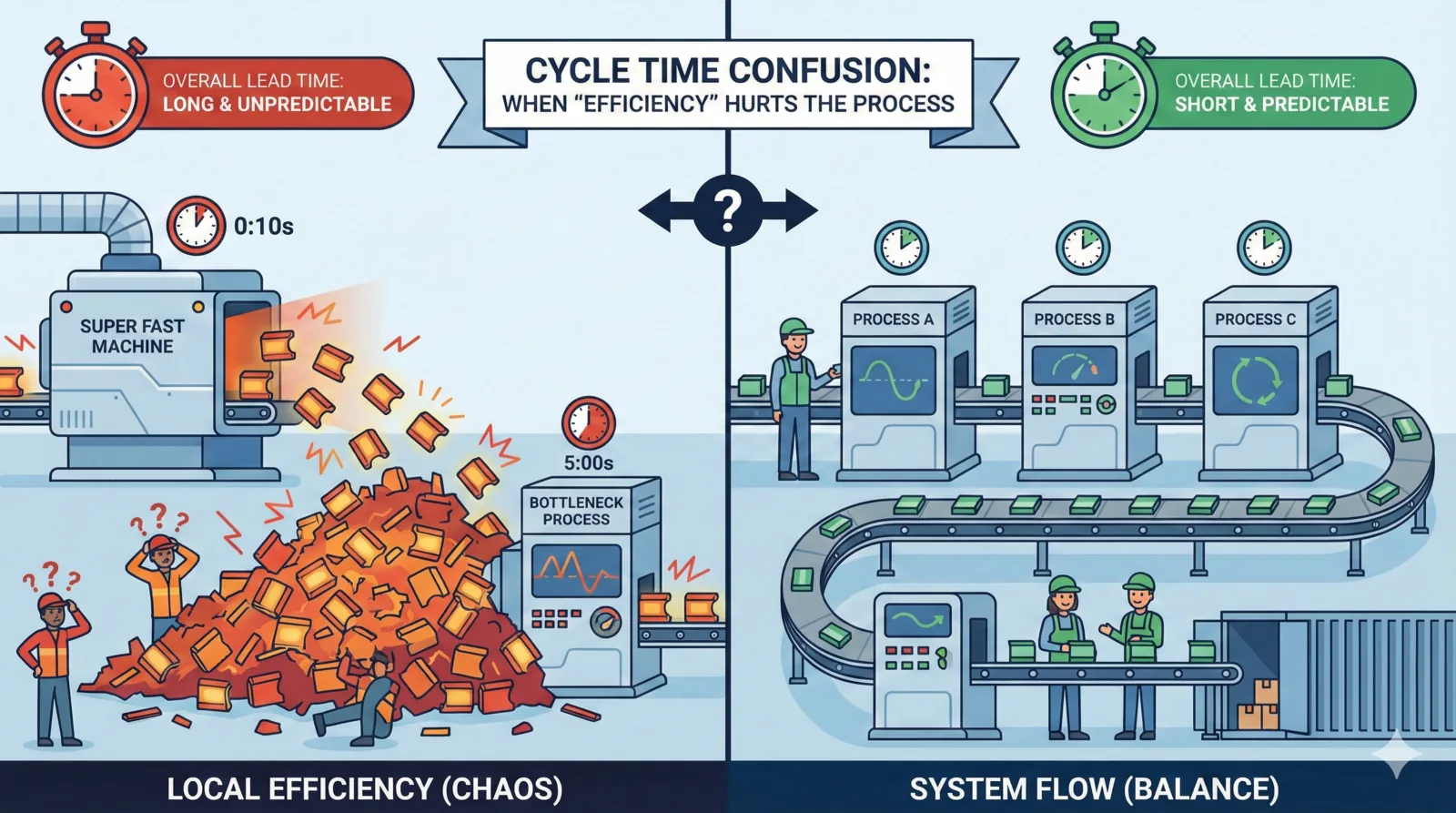
Walk through almost any growing factory and you’ll hear proud statements like:
- “We reduced the cycle time on this machine.”
- “Now it runs nearly twice as fast.”
- “Look at this new program, it’s super-efficient.”
On the surface, this sounds like progress.
Shorter cycle time → more parts → more output, right?
Not always.
In real factories — especially in woodworking and furniture manufacturing in India — chasing speed at individual machines often makes performance worse, not better. You see:
- More waiting,
- More WIP,
- More space occupied,
- And still… late orders.
The root problem is cycle time confusion:
Treating local speed as the same thing as system performance.
Let’s unpack why this happens and how to think about cycle time in a way that actually helps your factory.
The Obsession with Speed
Most improvement discussions start here:
“How can we make this machine faster?”
Engineers tweak programs, increase feed speeds, reduce tool changes. Operators are pushed to keep the machine running every second of the shift.
And to be fair, local cycle time improvements are useful — but only when they support the overall flow.
The problem shows up when:
- Each department tries to “show efficiency” by maximising its own output.
- Machines are judged on busy time, not on their contribution to finished orders.
- Managers celebrate high utilisation even when finished goods are not moving faster.
You end up with an odd situation:
- Machines are “more efficient” on paper,
- But lead time and on-time delivery do not improve,
- The shopfloor actually feels more chaotic.
That’s a sign that local efficiency has started to hurt the process.
The Real Decider: Your Slowest Step
Every production system has a natural slow step — the process that limits how much you can ship per day or per week.
This might be:
- A CNC with complex programmes,
- A bottleneck edge bander,
- A constrained finishing area,
- Or assembly space that can only handle so many jobs at once.
No matter how fast every other step runs, your total output can’t go faster than this slowest step.
Yet what many factories do is:
- Push upstream machines to run at maximum speed,
- Even when the next steps cannot keep up,
- Creating huge piles of semi-finished parts that just sit and wait.
In other words:
- One part of the system is sprinting,
- While the true constraint is jogging,
- And the factory as a whole is limping.
The slow step already sets the pace. Making an upstream machine twice as fast does nothing for overall output if that slow step is untouched.
Worse, it usually creates more problems:
- More WIP to manage,
- More mix-ups and damage,
- More searching and sorting,
- Less visibility on what is actually urgent.
Efficiency vs. Smooth Flow
Real efficiency is not about making one station “heroic”. It’s about smooth, predictable flow from first step to last.
A simple analogy: traffic.
- If one car starts weaving through traffic at 120 km/h while the rest of the road is crawling at 20 km/h, does everyone arrive faster?
- No. The road capacity is still defined by the most congested point.
Same in factories:
- A blazing fast CNC does not help if edge banding is always waiting for programs or separated parts.
- A high-speed saw does not help if drilling is understaffed and assembly is overloaded.
- A “super-efficient” drilling machine just creates a mountain of parts that assembly can’t absorb.
Smooth flow looks boring from a distance:
- No massive piles,
- Machines not always running flat out,
- People sometimes waiting a bit so the system stays balanced.
But boring flow usually beats exciting chaos.
Common Mistakes When Chasing Cycle Time
Across different factories, a few patterns repeat whenever cycle time is misunderstood.
1. Celebrating local speed while WIP explodes
- Cutting or nesting goes faster and faster,
- Stacks of panels queue up at edging,
- Trolleys fill every corridor,
- Operators waste time searching for the right batch.
Floor space begins to look “too small”, but the real issue is too much unfinished work.
2. Buying faster machines without checking the rest of the line
A factory invests in:
- A faster beam saw,
- A high-speed edge bander,
- Or a second CNC.
But no one asks:
- Can drilling, routing, and assembly keep up?
- Do we have clear routing and product families?
- Is material staging ready for that speed?
Result:
- Big EMI,
- Impressive brochure numbers,
- Modest impact on overall daily dispatch.
3. Filling the shift “just to keep people busy”
Supervisors feel pressure to show that machines are always running. So even if:
- The planned work for today is already finished,
- Or downstream is clearly overloaded,
they keep producing:
- Extra panels “for tomorrow”,
- Variants of components that may change,
- Or generic semi-finished inventory with no clear order.
Short term, utilisation looks good.
Long term, the system clogs.
4. Complaining about space while 60% is WIP storage
Many factories plan expansions because “we have no space.”
But when you walk the floor:
- Large areas are occupied by half-finished orders,
- Trolleys hold parts waiting for matching pieces,
- Finished wardrobes or kitchens are stuck waiting for one missing item.
In some cases, the factory doesn’t need more space.
It needs less work in progress — which means less over-production at “efficient” stations.
A Better Way to Think About Cycle Time
Cycle time is still an important concept. The problem is how we use it.
Here’s a more useful way to think:
-
Customer pace (takt time)
- Roughly: how often do you need to finish a job to meet demand?
- Example: if you must ship 40 wardrobes in an 8-hour shift, your average pace is 1 wardrobe every 12 minutes.
-
Bottleneck capability
- At your slowest step, can you realistically hit that pace?
- If not, that’s where improvement should focus first — not the fastest machine.
-
Balanced flow around the bottleneck
- Upstream and downstream steps should be tuned so:
- They feed and empty the bottleneck reliably,
- They don’t drown it with chaos or starve it.
- Upstream and downstream steps should be tuned so:
In this view:
- Cycle time improvements at the bottleneck are golden.
- Cycle time improvements far away from the bottleneck can be harmful if they create more WIP than the system can digest.
A Simple Example
Imagine a simplified wardrobe line:
- Cutting can produce 80 wardrobes’ worth of parts per day,
- Edge banding can handle 60,
- Drilling can handle 70,
- Assembly can handle 55.
Your true system capacity is 55 wardrobes per day, because assembly is the slowest step.
Now suppose you:
- Optimise cutting to 100 wardrobes’ worth per day,
- Keep everything else unchanged.
What happens?
- Cutting looks amazing — big numbers, short cycle time.
- Edge banding and drilling get flooded.
- Assembly still finishes 55 wardrobes per day (and now under more pressure).
- WIP and confusion increase.
Now suppose instead you:
- Keep cutting at 80,
- Improve assembly from 55 → 65 by better layout, fixtures, and problem-solving,
- Balance edge banding and drilling around that new pace.
Total output increases.
Lead time shrinks.
WIP can actually reduce.
Same number of machines.
Same building.
Very different system performance — because you focused where it matters.
Practical Steps for Woodworking and Furniture Factories
So what can you actually do with this?
Here’s a practical path for factories in India dealing with high mix and changing demand.
1. Identify your real bottleneck for a key product family
Pick one value stream, for example:
- Modular wardrobes,
- Kitchens,
- Office workstations.
For that family, map:
- Cutting → edging → drilling → routing → assembly → packing.
Estimate (even roughly):
- How many jobs each step can complete per day,
- Under current staffing and realistic, not theoretical, speeds.
Your slowest step is the current constraint. That’s where true cycle time improvement really pays off.
2. Stop over-producing upstream “to be efficient”
For that same product family:
- Limit the work that cutting or CNC produces each day to what edging and assembly can reasonably handle.
- Use clear job limits or cards — once today’s work is cut, stop cutting more of that family.
This feels uncomfortable at first.
But watch what happens to:
- Floor space,
- Searching time,
- Firefighting around missing parts.
You’ll likely see less noise and more control, even if some machines are not running 100% of the time.
3. Use cycle time improvement where it counts
Run improvement activities primarily at or near the bottleneck:
- Better fixtures to reduce changeover,
- Improved work instructions and jigs,
- Reduced walking and searching,
- Clear quality checks to avoid rework later.
Small gains at the bottleneck often beat big gains anywhere else.
4. Make flow visible, not just local numbers
Instead of tracking only:
- Pieces per hour per machine,
- Or machine utilisation,
also track:
- Lead time from first cut to packing,
- WIP at each key stage,
- Number of orders completed on time.
Visual boards or simple digital views that show flow health help everyone understand that the goal is finished orders, not local speed.
These are common patterns in the line optimisation projects I’ve worked on — the biggest gains come from seeing the line as a whole instead of as isolated machines.
5. Train teams to think system, not station
Many operators and supervisors are rewarded for:
- Keeping “their” machine busy,
- Hitting a local target,
- Showing impressive hourly counts.
Shift the narrative to:
- “How did our line perform today?”
- “Did we help or hurt flow by what we produced?”
- “What stopped us from shipping more complete, good orders?”
Short daily huddles at line level can make this mindset real. Over time, people learn to pause production when the next step is overloaded — a strong sign that cycle time thinking is maturing.
A Quick Checklist Before You “Make It Faster”
Next time someone proposes a cycle time improvement, run through this short checklist:
-
Is this step the bottleneck for this product family?
- If no, why do we need it faster?
- If yes, great — let’s understand the impact on overall output.
-
Can the next step handle the extra volume?
- If not, what will happen to WIP and space?
-
Will this help us ship more complete orders on time?
- Or will it just move the waiting point to another station?
-
Do we have a way to limit over-production?
- Can we cap how much we run per day so we don’t flood the line?
-
What problem are we really trying to solve?
- Customer lead time?
- Late orders?
- High WIP?
- Or just a desire to see a “better” machine number?
If you can’t answer these clearly, pause. The improvement may be technically clever but system-wise harmful.
Final Thought: Flow First, Speed Second
Cycle time is not the enemy.
Chasing it blindly is.
Great factories don’t obsess about making every machine as fast as possible. They obsess about:
- Keeping flow smooth,
- Protecting their true bottleneck,
- Reducing WIP and confusion,
- And shipping reliable, complete orders.
When you think this way, “efficiency” stops being about a single shiny number on one machine. It becomes about how calmly and consistently your entire line runs.
If you want to go deeper into this kind of whole-system thinking, the experience and projects on my resume page reflect the same principle:
First, make the process work. Then, make it fast.
Comments (0)
Loading comments...
Leave a Comment