
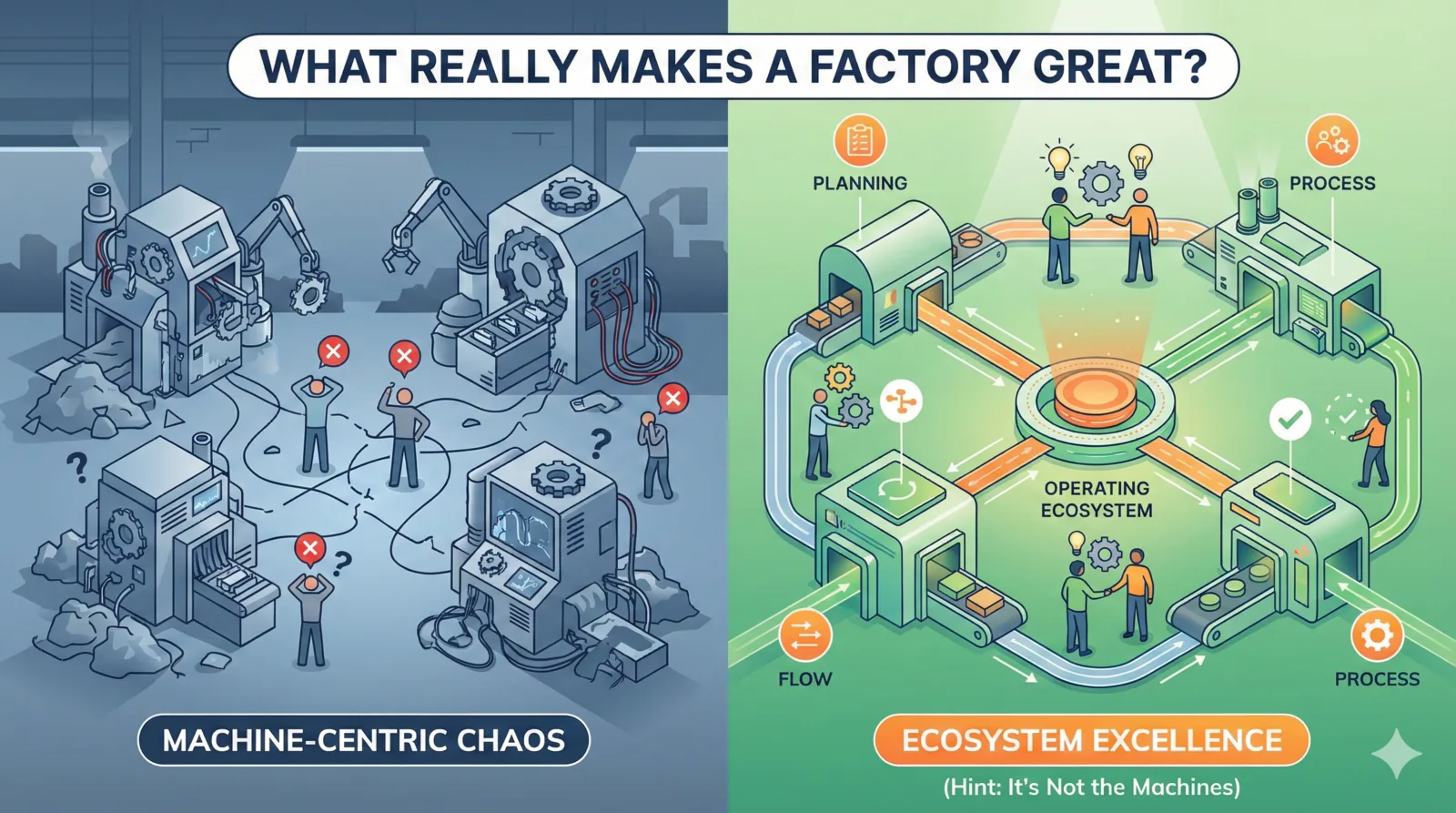
Walk into any growing factory and you’ll hear some version of this plan:
“We’ll upgrade the CNC, add another edge bander, maybe a robotic arm—and then our problems will be solved.”
A year later, the same factory often has:
- New machines,
- Higher EMIs,
- Exactly the same chaos—or worse.
Orders still run late. WIP still piles up. Firefighting is a daily sport.
If great factories were only about great machines, this wouldn’t happen. But it does, repeatedly.
The truth is simple:
It’s not the equipment alone that makes a factory great.
It’s the ecosystem around that equipment.
In this article, we’ll unpack what that ecosystem is, how to recognise when it’s broken, and what you can do—especially in Indian woodworking and furniture factories—to build a factory that performs consistently, even without the “shiniest” machines.
The Myth of “Equipment-Centric” Excellence
For many owners and decision-makers, the journey to improvement starts with a catalogue.
New CNC.
New edge bander.
New automatic drilling line.
Each new purchase promises:
- More capacity,
- Better quality,
- Lower labour dependence.
On paper, it makes sense. In reality, I’ve seen this pattern in multiple assignments:
- A high-end machine is installed,
- Initial excitement is high,
- After a few months, output is only slightly better—or not at all,
- The shopfloor team quietly starts saying:
“Machine is good, but our issues are somewhere else.”
The problem is not that the machine is bad. The problem is that it was dropped into an ecosystem that was not ready to use it properly.
You don’t fix systemic issues by upgrading a single node.
What Is the “Ecosystem” in a Factory?
A high-performing factory is more than the sum of its machines. It is a coordinated ecosystem where many elements work together.
At a minimum, that ecosystem includes:
-
Process flow and material movement
How parts move from cutting to edging, drilling, assembly, and dispatch. -
Balanced workloads across stations
No step is permanently overloaded while others are waiting. -
Trained and organised people
Operators, supervisors, planners, and helpers know what to do, when, and how. -
Layout that supports flow, not fights it
Machines are placed according to product families and sequence, not “where space was available.” -
Information visibility and planning systems
Clear priorities, realistic schedules, and simple ways to see what’s happening right now.
When these elements are aligned, even modest machines can deliver impressive throughput.
When they are misaligned, even the most advanced automation cannot save you.
Red Flags: When the Ecosystem Is Broken (Even with Great Machines)
You don’t need a complex audit to see if your ecosystem is weak. A few hours on the shopfloor will show you.
Typical red flags:
-
Operators constantly searching
- Looking for tools, clamps, trolleys, or job sheets.
- Asking, “Which job do we run next?” multiple times a shift.
-
Machines idling between jobs
- Waiting for material from the previous step,
- Waiting for programs, tools, or approvals,
- Waiting for a decision: “Should we run this urgent job first?”
-
WIP piling up at certain points
- Parts stacked near drilling or assembly,
- Half-finished wardrobes waiting for one missing component,
- Trolleys parked in corridors, making movement difficult.
-
Frequent firefighting and rescheduling
- Daily, sometimes hourly, changes in priorities,
- Last-minute jobs pushing others out,
- Teams spending more time reacting than improving.
-
Blame loops between departments
- Sales blames production,
- Production blames design or purchase,
- Design blames unclear inputs from sales.
None of these are solved by adding one more machine.
They are symptoms of an ecosystem that needs attention.
You Can’t Buy Your Way Out of Inefficiency
It’s easy to confuse capacity with productivity.
Capacity is: “How much could we theoretically produce if everything was perfect?”
Productivity is: “How much do we reliably ship, on time, with good quality?”
A common pattern:
- Output is lower than expected.
- Everyone feels busy, so the machine must be the bottleneck.
- The factory buys a second (or bigger) machine.
- WIP increases, but on-time delivery doesn’t improve much.
- The bottleneck simply moves or becomes less visible.
In one real-life kind of case:
- A factory felt its CNC was the constraint.
- They considered adding another CNC line.
- On closer analysis, we found:
- Programs were prepared late,
- Material was not staged in time,
- Assembly had limited space and slow problem resolution.
Once planning and assembly were improved:
- The existing CNC handled the load comfortably,
- Lead times improved,
- The “need” for an extra CNC disappeared.
The lesson:
Real productivity comes from orchestrating flow, not just adding horsepower.
What Really Makes a Factory Great: Four Core Elements
If it’s not just machines, what actually separates an average factory from a great one?
From repeated patterns across factories, four core elements show up again and again.
1. Clear, sensible flow
- Material moves mostly forward, not back and forth.
- Product families have defined paths through the factory.
- Main routes for trolleys and forklifts are protected and kept clear.
- WIP buffers exist, but with intention and limits—not “wherever we found space.”
When flow is clear:
- Supervisors can see problems quickly,
- Operators know where to send the next trolley,
- It becomes much easier to balance workloads.
2. Stable, visible planning and priorities
Great factories don’t rely on:
- Last-minute WhatsApp messages,
- Endless phone calls,
- Paper slips taped on machines.
Instead, they have:
- A realistic planning rhythm (daily/weekly),
- A simple way to show today’s priorities,
- Mechanisms to handle urgent jobs without derailing everything else,
- Basic but trusted data on capacity and load.
You don’t need the most complex software. You need a planning system that people actually follow.
3. Capable, respected people
In truly good factories:
- Operators are trained properly, not just “shadowing” someone for a day,
- People understand why standards exist, not just that “management wants it,”
- Suggestions from the shopfloor are encouraged and acted on,
- Mistakes are treated as signals to improve the system, not just reasons to blame individuals.
Machines may be the visible assets, but people are the real performance engine.
4. Simple, enforced standards and problem-solving habits
Great factories have:
- Clear work instructions (visual if possible),
- Simple checks and OK/NOT OK criteria at key points,
- A habit of asking “why” a few times when issues repeat,
- A bias towards fixing causes, not just symptoms.
This doesn’t require a huge Lean program. It requires discipline in small things:
- Start-of-shift checks,
- Basic 5S around critical stations,
- Quick daily huddles to surface issues.
Two Factories, Same Machines, Very Different Outcomes
Consider two woodworking factories in India with broadly similar equipment:
- CNC router,
- Panel saw,
- Edge bander,
- Drilling station,
- Assembly area.
Factory A – Machine-centric
- Machines are placed largely where space was available.
- Planning changes constantly; shopfloor hears priorities through phone calls.
- Programs are often prepared at the last minute.
- Operators wait for clarifications on drawings and hardware.
- There is no consistent way to see what’s stuck where.
Result:
- WIP everywhere,
- Operators feel rushed but output is mediocre,
- Customers experience unpredictable lead times,
- Management feels “we need more machines.”
Factory B – Ecosystem-centric
- Machines are arranged by product family and sequence.
- A simple board or screen shows the day’s plan per line.
- Programs are prepared and verified before the shift starts.
- Standard trolleys and parking locations reduce searching.
- Short daily meetings flag issues and assign actions.
Result:
- Less running around, more actual value-adding work,
- Problems surface early and are fixed faster,
- Output and on-time delivery steadily improve,
- The same machines look “world-class” simply because the system around them works.
The difference is not the catalogue.
It’s the ecosystem.
Practical Steps to Build a Great Factory Ecosystem
You don’t have to transform everything at once. In fact, it’s better if you don’t.
Here’s a phased approach that works in real factories.
Step 1 – Map one core value stream
Pick a critical product family (e.g. wardrobes, kitchens, or office workstations) and:
- Map the steps from order receipt to dispatch,
- Note where material waits,
- Note where information is unclear,
- Note which station decides the pace for everything else.
This gives you a shared picture of reality.
Step 2 – Do a “waste walk”
With that map in hand, walk the shopfloor and look for:
- Waiting (people or machines),
- Unnecessary movement (people or material),
- Over-processing (rework, repeated checks),
- Confusion (people asking what to do next).
Capture observations visually if possible (photos, quick sketches). This is not about blaming; it’s about seeing.
Step 3 – Fix obvious friction first
Start with low-risk improvements:
- Mark standard locations for tools and trolleys,
- Clarify who releases jobs to each machine,
- Create simple visual tags or travellers for jobs,
- Remove old WIP that will never move.
The aim is to create a bit of breathing space in the system.
Step 4 – Rebalance key steps
Look at your core flow and ask:
- Which step is truly the bottleneck?
- Which steps are over-producing or under-producing?
- Where can small changes (e.g., changeover reduction, better staging) make a big difference?
You may find that:
- One machine needs slightly more uptime,
- Another should produce in smaller, more frequent batches,
- Assembly needs clearer instructions and more structured space.
Step 5 – Strengthen planning and visibility
Even with simple tools:
- Lock a planning rhythm (daily/weekly),
- Decide who can change the plan and under what conditions,
- Provide a visible, single source of truth for the day’s priorities.
When everyone sees the same plan, coordination improves immediately.
Step 6 – Only then consider major equipment changes
After doing the previous steps, you will have a much clearer picture of:
- Whether you truly need new equipment,
- What kind of equipment will fit your flow,
- Where layout changes should happen,
- How software and machines should talk to each other.
This is where structured investment in machines—and in solution design—can give you multiplying returns, not just more moving parts.
Many of the patterns described here appear repeatedly in the projects and factory improvement stories summarised on my resume page.
The Role of Machines in a Great Factory
All of this does not mean machines don’t matter. They absolutely do.
- Good machines are more repeatable,
- They can handle difficult jobs reliably,
- They reduce skill dependency in certain operations.
But machines are members of a system, not the system itself.
A great factory:
- Chooses machines that fit its flow and product mix,
- Installs them in a layout that supports that flow,
- Integrates them with planning and information,
- Trains people to use them intelligently,
- Continuously tunes the ecosystem around them.
That’s very different from:
“Buy the latest machine, hope everything gets better.”
Final Thoughts: Build the Ecosystem, Then the Showroom
It’s tempting to think of factory improvement as a sequence of purchases:
- New software this year,
- New edge bander next year,
- New CNC the year after.
But the factories that truly stand out—in woodworking, furniture, and beyond—don’t just collect equipment. They design and nurture an ecosystem.
So, the next time you’re planning an upgrade, try a different starting question:
Instead of:
“Which machine should we buy?”
Ask:
“What do we want our factory ecosystem to look like—and what is the next small step towards that?”
Machines will still matter.
But they’ll finally be operating in a factory that deserves them.
Comments (0)
Loading comments...
Leave a Comment