
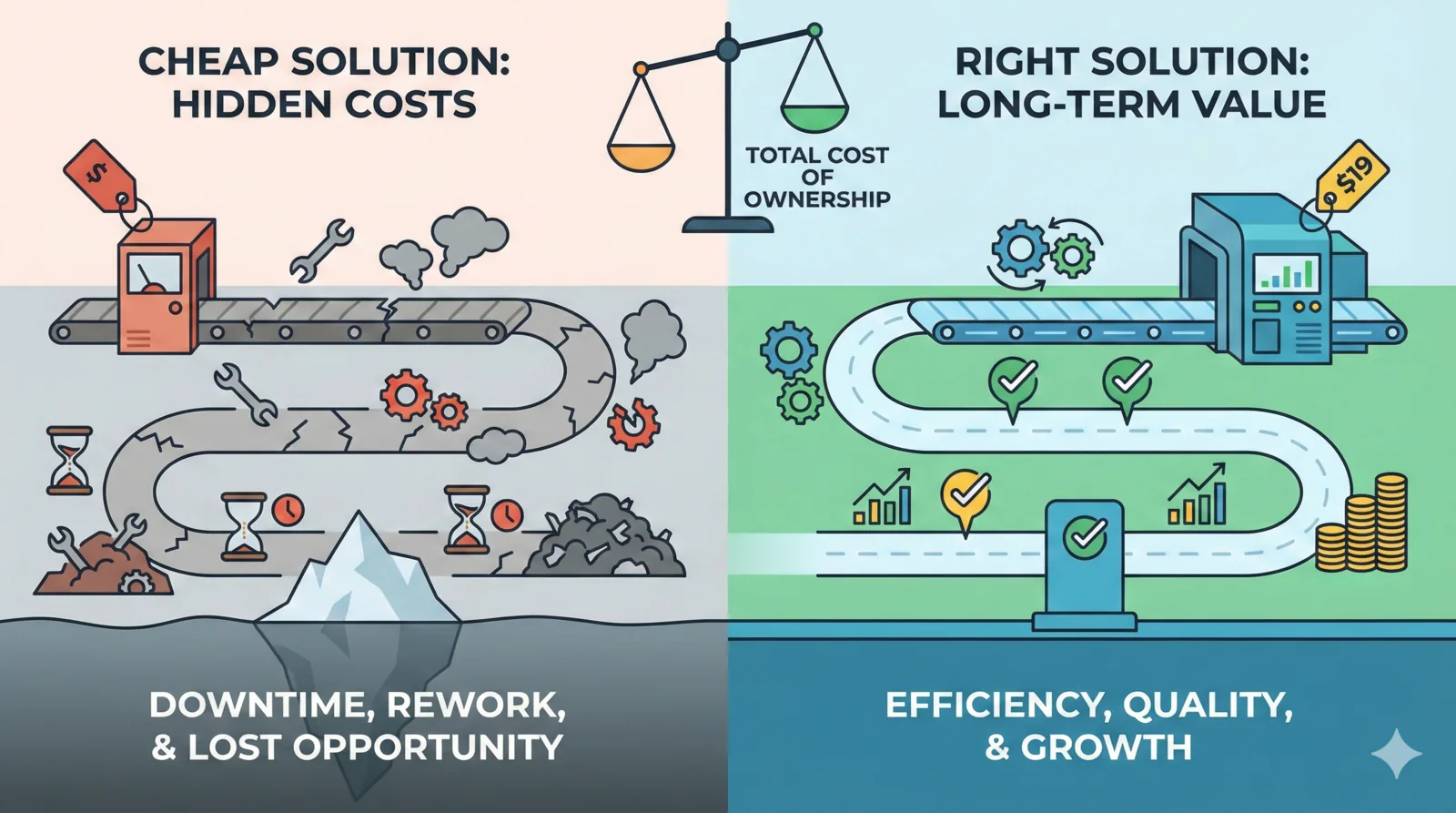
One of the most common statements I hear in factory discussions is:
“Why should I pay for this solution that’s more than twice as expensive as another one? Even if the cheaper one doesn’t work out, I can still modify or replace it and spend less overall.”
On the surface, this sounds completely logical.
In some situations, it is a reasonable approach. But in most real factories—especially those with tight timelines, complex products, or ambitious growth plans—this way of thinking quietly creates costs that are much higher than the price difference on the quotation.
The real problem is simple:
We focus on the purchase price and ignore the total cost of living with that decision.
Let’s unpack that.
When Cheaper Actually Makes Sense
Before we criticise “cheap”, let’s be fair.
Cheaper machines or solutions can be a smart choice when:
- You’re testing a new business model or product and want to limit upfront risk.
- The process is non-critical – a support activity where precision, integration, or uptime don’t matter much.
- You have short-term, clearly limited usage – a project that will end in a year or two.
- You’re deliberately buying something to learn from, not to scale with.
In these cases, going with a budget option can be a strategic decision. The key is being honest about what you’re trading off:
- You accept lower performance.
- You accept more manual work.
- You accept that you may replace it sooner.
The problem begins when we apply this thinking to core processes in woodworking and furniture factories in India and elsewhere—cutting, edging, drilling, finishing, planning, or core software that coordinates all of this.
Where the Real Cost Hides (It’s Not on the Invoice)
In most medium- to long-term operations, what looks like “smart saving” at purchase time turns into hidden costs over the next 3–5 years.
Some of the common ones:
Frequent downtimes and reactive maintenance
A cheaper machine that stops unpredictably doesn’t just cost repair money. Every stoppage:
- Delays orders.
- Disrupts planning.
- Forces people into firefighting mode.
The line keeps “breaking flow” and everyone pays the price—sales, production, even customer service.
Incompatibility with existing systems
The machine or software “works”, but:
- It doesn’t talk to your existing software or machines.
- Programs can’t be shared easily.
- Data has to be retyped manually.
- You depend on one or two people who “know how to handle it”.
So instead of a clean, connected system, you get patchwork operations that run on tribal knowledge.
Inflexibility when your product mix changes
It works fine for today’s design and material. But:
- New edge profiles fail.
- Different board types cause issues.
- New customer requirements suddenly need workarounds or manual steps.
Your business evolves. The “cheap” solution often doesn’t.
Inconsistent quality and rework
A small variation in accuracy or finish can:
- Increase rejection and rework.
- Make assembly harder.
- Annoy customers who get inconsistent results from batch to batch.
Over time, this eats into margins quietly. You’re working harder to stand still.
On day one, the cheaper option wins.
On day 365, the picture often looks very different.
The Total Cost of Ownership (TCO) Question
The real question is not:
“How much does this machine/software cost?”
It is:
“What is the total cost of using, maintaining, and depending on this decision for the next 3–5 years?”
Some of the elements that go into Total Cost of Ownership (TCO):
Purchase price
The number on the quotation.
Easy to compare, easy to negotiate, easy to focus on—and very visible.
Installation and integration
- Foundations and utilities.
- Dust collection, electricals, networking.
- IT setup and interfaces to existing systems.
- Time spent by your own engineers to make it all work together.
These don’t always show up clearly in the comparison sheet.
Training and learning curve
How long before your team can:
- Use it confidently?
- Troubleshoot basic issues?
- Integrate it into daily work without constant support?
Cheaper tools can become very expensive if they need a “hero” operator just to stay alive.
Running costs
- Energy
- Consumables
- Tools and spares
- Service visits
Sometimes the “expensive” solution runs cheaper per part over the long term.
Downtime impact
Each hour of stoppage is not just maintenance cost. It is:
- Lost production capacity.
- Overtime later to catch up.
- Potential delays, penalties, or cancelled orders.
This is often the biggest invisible cost.
Upgrade and scalability
Can this solution grow with you?
Or will you hit a wall in 12–24 months and be forced to buy again, re-train again, and re-integrate again?
When you look at TCO, the “expensive” option often turns out to be more predictable, stable, and cheaper per unit of output.
A Simple Example: The Math Behind a “Cheap” Mistake
Imagine two machines for a core process in a medium-sized woodworking factory in India:
-
Machine A (Cheaper)
- Cost: ₹25 lakh
- Lower reliability, limited local service
- Average 8 hours of unplanned downtime per month
-
Machine B (Higher upfront cost)
- Cost: ₹40 lakh
- Strong local service support
- Average 2 hours of unplanned downtime per month
Suppose that when this machine is down, you lose roughly ₹15,000 of margin per hour (not revenue, margin).
Over one year:
-
Machine A downtime cost:
8 hours × 12 months × ₹15,000 = ₹14.4 lakh -
Machine B downtime cost:
2 hours × 12 months × ₹15,000 = ₹3.6 lakh
Difference in downtime cost in just one year = ₹10.8 lakh.
On paper, Machine A was ₹15 lakh cheaper to buy.
In reality, in 1–2 years, the “saving” starts disappearing into downtime and lost opportunities.
And this still doesn’t include:
- Overtime to catch up.
- Stress on the team.
- Occasional loss of customers.
- Extra supervision effort.
The more critical the process, the faster these “hidden” costs add up.
Expensive ≠ Better. But Fit ≠ Optional.
It’s important to be clear:
Not every expensive machine is better. Some are overengineered or packed with features you don’t need.
Paying more just to pay more makes no sense.
The right question is:
“Does this solution fit the way we work now, and the way we want to work in the next few years?”
Good “fit” usually has several layers:
Process fit
- Does it support your actual product mix, volumes, and tolerances?
- Does it handle the materials you really use, not just demo samples?
People fit
- Can your current team run and maintain it with realistic training?
- Or does it require rare, expensive skills that are hard to find or retain?
System fit
- Does it connect smoothly with your existing machines and software?
- Or will you be stuck in manual transfers and Excel glue code forever?
Vendor fit
- Is the supplier capable and committed to supporting you in your region?
- Do they understand your industry, not just the machine?
The best solution is the one that matches your needs today and supports your direction tomorrow.
That may be mid-range. It may be premium. But it is almost never the cheapest by default.
A Better Way to Decide Between Options
Instead of asking only:
“Why is this machine/software so expensive?”
Try questions like:
- “What risks does this help me avoid?”
- “What problems does this solve that cheaper options don’t?”
- “What does it save me in time, energy, and inefficiencies over the next few years?”
- “If things go wrong, what is the cost of failure, not just the cost of the machine?”
A simple decision approach you can use in your next investment discussion:
1. List your non-negotiables
For example:
- Uptime and service response.
- Accuracy and finish level.
- Type of materials and board sizes.
- Integration requirements (software, data, automation).
2. Score each option for fit, not just price
Use simple 1–5 scores for:
- Reliability and service.
- Integration capability.
- Flexibility for future products.
- Ease of use for your team.
Price is just one column in that table.
3. Estimate a basic TCO over 3–5 years
Include:
- Purchase + installation.
- Training and initial learning curve.
- Expected maintenance and service.
- A rough cost of downtime (based on past experience).
You don’t need perfect numbers. Even an approximate comparison often changes your view.
4. Talk to existing users
Ask other factories using the same solution:
- What goes wrong in real life?
- How fast does the supplier respond?
- What do they wish they had known before buying?
Real-world stories are often more valuable than marketing brochures.
5. Run a “what if we’re wrong?” scenario
If this decision fails:
- How easy is it to fix, upgrade, or exit?
- What is the worst-case impact on your customers?
- How much sunk cost will you create—in money and in time?
This process doesn’t take weeks. It just requires a bit more structured thinking than “Option A is 30% cheaper, let’s go with that.”
Signs You’re Underestimating the Real Cost
From work with factories and SMEs, some typical warning signals:
-
Investment discussions end with:
“This is the cheapest—let’s try it. We’ll manage somehow.”
-
Decisions are driven mainly by purchase price and discount, not by performance over time.
-
People on the shop floor say:
- “We keep fixing the same issue.”
- “This machine is fast but we don’t trust it.”
- “If that one person is absent, the system collapses.”
-
Upgrades become frequent: you replace or heavily modify machines after just 1–2 years.
If any of this sounds familiar, your factory is already paying the real cost of “cheap”—just spread out across many line items.
Putting This into Practice in Indian Woodworking Factories
In Indian woodworking and furniture factories—whether around Bangalore, NCR, Pune, or in tier-2 cities—the context adds a few more challenges:
- Buildings are often shared or rented, so expansion is not always straightforward.
- Product mixes are diverse and changing – kitchens, wardrobes, offices, custom furniture.
- Skilled technical resources can be limited, so service response and local support matter even more.
In such an environment, the right solution is not simply the most powerful or the most modern. It is the one that:
- Handles your current and near-future product mix,
- Can be supported with the skills available locally,
- Integrates with your planning and data systems,
- Gives you predictable performance day after day.
In many of the line optimisation and tooling projects I’ve been involved in, the real value has come from helping factories reframe the decision from:
“How do we save maximum on this purchase?”
to:
“How do we ensure this investment supports our flow, people, and growth for years?”
You can see more of this broader perspective on my resume page.
Final Thoughts: What Are You Really Paying For?
As a consultant, my role is not to always recommend the premium option.
Sometimes, the correct advice is:
- “This cheaper solution is enough for your current stage. Don’t overspend now.”
Other times, it is:
- “If you go for the cheapest option here, you will pay for it many times over in downtime, complexity, and lost customers.”
The real mistake is not choosing a cheaper machine or a premium one.
The real mistake is choosing without clearly understanding what you’re really paying for.
Next time you’re tempted to ask:
“Why should I pay more?”
Also ask:
“What will this decision cost me in time, stress, and lost opportunities if I get it wrong?”
That’s where the real price of a solution lives—and that’s where the right investment often pays for itself many times over.
Comments (0)
Loading comments...
Leave a Comment