
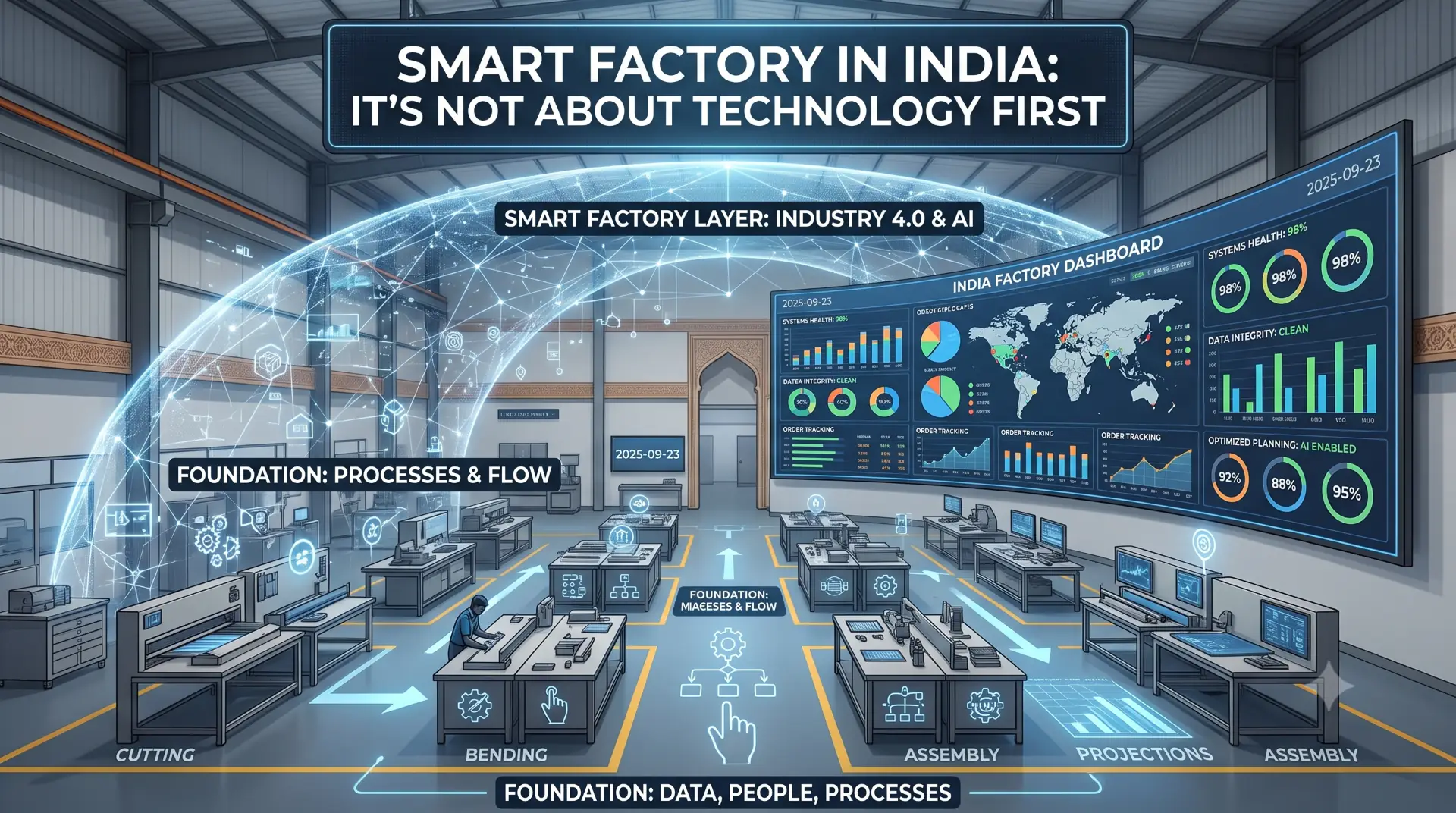
A production head is standing in front of a large screen.
The dashboard looks impressive. Machines are connected. Orders have colours. Utilisation is shown in neat percentages.
Ten metres away, an operator is asking:
“Sir, ab next kaunsa job chalana hai?”
(Sir, which job should we run next?)
That gap explains a lot about the smart factory conversation in India.
We often start with technology.
IoT sensors. MES. Artificial intelligence. Real-time dashboards. Automated machines. Digital work instructions.
All useful.
But none of them automatically make a factory smart.
The visible problem may be a lack of technology. The real problem is often much more ordinary: poor flow, weak processes, unreliable data and unclear decisions.
Digitising that does not remove the problem.
It simply gives the problem a login screen.
What Does a Smart Factory Actually Mean?
A smart factory is often described through technology.
Connected machines. Sensors. Data collection. Automation. Digital twins. AI-based planning.
But technology is only one layer.
A factory is genuinely smart when it can reliably answer basic operational questions:
- What needs to be produced today?
- Is the required material available?
- Is the information released to production correct?
- Where is each order?
- What is blocking it?
- Which operation is becoming overloaded?
- Can we realistically meet the promised delivery date?
- When something goes wrong, does the information reach the right person quickly?
You can answer some of these questions with software.
You can also spend a lot of money on software and still not answer them.
That distinction matters.
A smart factory is not one with the maximum number of connected devices.
It is one where information, material, machines and people work together with minimum confusion.
Technology helps enormously once that system exists.
The Technology-First Trap
The usual smart factory journey starts innocently.
Management visits an exhibition or another plant. Someone demonstrates a live production dashboard. A machine supplier shows remote monitoring. A software company presents automatic scheduling.
Soon the discussion becomes:
“We should also implement this.”
But what exactly are we trying to fix?
That question often arrives surprisingly late.
So sensors are installed while production planning still changes five times during the day.
Machines are connected while material has no clear route through the factory.
A production tracking system is introduced while nobody agrees on when an operation should actually be considered complete.
Management gets more data.
The shopfloor gets one more thing to update.
And after six months everyone wonders why the expected improvement never arrived.
The technology may be working perfectly.
The factory around it is not.
A Bad Process Does Not Become Better When Digitised
Suppose panels currently travel from cutting to one end of the factory for edge banding, come back towards the centre for drilling and then cross the same route again for assembly.
Add digital tracking.
Now you know exactly where the badly routed panel is.
Useful? Yes.
Solved? No.
Suppose production starts jobs even when drawings, hardware or material are incomplete.
Install an MES.
Now the MES can record with great precision that the job is waiting.
Again, useful information.
But the root problem is still work being released before it is ready.
This is where digital factory projects become confused.
Visibility and improvement are not the same thing.
Technology can reveal poor processes. It can enforce good processes. It can automate repetitive work.
But it cannot decide what a good process should be unless the factory has first done that thinking.
This is closely related to the wider problem of digital factory projects failing before they start: the software is often selected before the operating problem is properly defined.
Start With Flow
Before talking about a smart factory, walk through the existing one.
Follow one real order.
Not the process shown in the SOP. The actual order.
Start from design release and follow it through:
Design → detailing → material → cutting → edging → drilling → assembly → finishing → packing → dispatch.
Watch where it waits.
Watch where it travels backwards.
Watch where someone has to make a phone call before work can continue.
Watch where parts accumulate.
In many furniture and woodworking factories, this exercise tells you more than a week of dashboard reviews.
You may discover that the biggest problem is not production speed at all.
It could be:
- incomplete information entering production,
- material being issued too late,
- poor batching,
- excessive WIP,
- unclear job priorities,
- or one downstream operation controlling the entire flow.
Fixing these may not look particularly futuristic.
The factory might not feature in an Industry 4.0 brochure afterwards.
It will, however, work better.
That seems a reasonable compromise.
WIP Is Often Hiding the Real Capacity
Another common conversation in Indian factories is:
“We need more space.”
Sometimes they genuinely do.
But sometimes a large part of the existing factory is occupied by work that should not be sitting there in the first place.
Half-complete orders.
Panels waiting for matching parts.
Jobs started too early.
Rejected components waiting for rework.
Material kept near machines because nobody trusts the storage system.
Then more space is added.
And within a surprisingly short period, the new space also fills up.
The visible problem was space.
The real problem was flow and WIP control.
A smarter factory does not simply track WIP digitally.
It asks why so much WIP exists.
Can work be released later?
Can batches be smaller?
Can incomplete orders be prevented from entering production?
Can upstream processes stop producing when downstream capacity is full?
Reducing unnecessary WIP can improve visibility, movement and lead time before a single sensor is installed.
Smart Factories Need Clean Data
Eventually technology enters the picture.
And then another uncomfortable problem appears: data.
Software assumes that the information fed into it means something.
Factories are less disciplined.
One routing says an operation takes 12 minutes. Reality says 28.
An item exists three times in the master under slightly different names.
A material is shown in stock but cannot actually be used for the required job.
Machine capacity is based on catalogue speed rather than real production.
Now install automatic planning.
The computer confidently produces a plan based on information nobody should have trusted.
Humans are quite capable of making bad decisions themselves. Automating the process just lets us make them faster.
For digital manufacturing systems to work, factories need discipline around:
- item and material masters,
- routings,
- realistic cycle times,
- machine availability,
- BOMs,
- revisions,
- inventory status,
- and order priorities.
Perfect data is unrealistic.
Reliable enough data, with clear ownership for correcting it, is not.
People Are Part of the Smart Factory
A machine can be connected in an afternoon.
People take longer.
This part is frequently underestimated.
A new system may require an operator to scan a job before starting it.
The operator sees another step.
Management sees traceability.
Both are correct.
If the operator receives no practical benefit from that scan, adoption will depend entirely on supervision.
Eventually somebody says:
“Baad mein entry kar dena.”
(Enter it later.)
Real-time tracking has now become end-of-shift historical fiction.
The answer is not stricter policing.
The system must make work easier as well as make work visible.
For example:
- The operator scans a job and immediately sees the correct drawing.
- The next priority is clear without calling the supervisor.
- Missing material is visible before the job reaches the machine.
- Quality requirements are shown at the workstation.
- A problem can be raised without searching for three different people.
Now digital adoption serves the shopfloor too.
That changes the conversation completely.
India Should Not Copy a Smart Factory Model Blindly
Indian manufacturing has its own operating reality.
Many factories work with high product variety, changing customer requirements, mixed levels of automation and a combination of experienced manual skill with modern machinery.
This is particularly visible in furniture and woodworking manufacturing.
One factory may have:
- a modern CNC nesting machine,
- an older edge bander,
- manual assembly,
- Excel-based planning,
- WhatsApp approvals,
- and highly experienced workers who solve half the factory's problems from memory.
Trying to copy a highly standardised European automotive model directly into that environment makes little sense.
The principles may transfer.
The exact system may not.
India also has advantages.
Teams can often adapt quickly. Smaller and mid-sized manufacturers can change processes without years of corporate approvals. Operators frequently have deep practical knowledge of products and machines.
That flexibility should be used.
The objective is not to make an Indian factory look like somebody else's smart factory.
It is to make this factory work better, then choose the technology that supports it.
A Better Smart Factory Roadmap
For most factories, the journey should happen in stages.
Stage 1: Understand the current factory
Map real order flow.
Identify:
- waiting,
- unnecessary movement,
- repeated data entry,
- excess WIP,
- missing information,
- rework,
- and actual bottlenecks.
Do not begin by asking which software to buy.
Stage 2: Stabilise the basics
Define:
- clear process stages,
- ownership,
- basic production priorities,
- material locations,
- WIP rules,
- job-release conditions,
- and practical operating standards.
The factory does not need to become perfect.
It needs to become understandable.
Stage 3: Clean the information
Review the master data needed for whatever system comes next.
Decide who owns it.
Remove duplicates.
Correct obvious routing and cycle-time errors.
Establish revision control.
If the input is wrong, an expensive system will merely produce expensive nonsense.
Stage 4: Digitise a real problem
Now choose one specific use case.
For example:
- production status tracking,
- machine monitoring,
- digital drawings at workstations,
- material traceability,
- planning,
- maintenance,
- quality reporting.
Define what improvement you expect.
Not “we will have live visibility.”
Something measurable:
“Supervisors currently spend two hours per day finding order status. We want to reduce that to fifteen minutes.”
Now technology has a job.
Stage 5: Connect systems gradually
Once individual digital processes work reliably, connect them.
Design can release production information directly.
Planning can use real machine capacity.
Machines can return production status.
Inventory can reflect consumption.
Quality can feed rework back into planning.
This is where a factory begins to become truly connected.
Not because everything has an API.
Because the information actually follows the work.
Technology Should Amplify What Already Works
Once the foundation is stable, technology becomes extremely powerful.
IoT can expose hidden downtime.
Machine data can improve maintenance.
Production tracking can give accurate order status.
Planning software can compare demand with capacity.
CAD/CAM integration can remove manual re-entry.
AI can analyse patterns that people cannot easily see across thousands of jobs.
Automation can remove repetitive handling and improve consistency.
But notice the sequence.
First understand the system. Then improve it. Then digitise it. Then automate where it makes sense.
Doing this backwards is how factories end up with isolated islands of technology.
A smart CNC cannot compensate for a bad drawing.
A perfect dashboard cannot compensate for material that never arrived.
AI cannot rescue a BOM that was wrong in the first place.
The department where a digital problem appears is rarely where it began.
That pattern runs through much of the factory improvement work discussed on the projects and experience pages.
What Should Factory Owners Ask Before Investing?
Before approving the next smart manufacturing project, ask five questions:
-
What operational problem are we solving?
Describe it without using the name of any technology.
-
What is causing that problem today?
Separate the visible symptom from the root cause.
-
Is the underlying process stable enough to digitise?
If not, fix it first.
-
Who will use the system every day, and what will they gain from it?
Adoption cannot depend forever on somebody standing behind the user.
-
How will we know the investment worked?
Use outcomes such as lead time, WIP, downtime, first-time-right quality or planning effort.
If those questions cannot be answered clearly, another vendor demonstration will probably not help.
The Smart Factory Is Built Before It Is Digitised
The smart factory conversation often starts with machines and software because those things are visible.
Processes are less exciting.
Data discipline is definitely less exciting.
And asking why jobs are sitting in the aisle does not photograph particularly well.
But that is where the real work starts.
For Indian manufacturers, becoming a smart factory does not mean replacing every manual process or connecting every object to the internet.
It means building a factory that understands its own flow, controls its work, develops its people and trusts its information.
Then technology can do what technology does very well:
make a good system faster, clearer and more capable.
The visible smart factory may be the dashboard.
The real smart factory is everything that had to work properly before the dashboard became useful.
Comments (0)
Loading comments...
Leave a Comment