
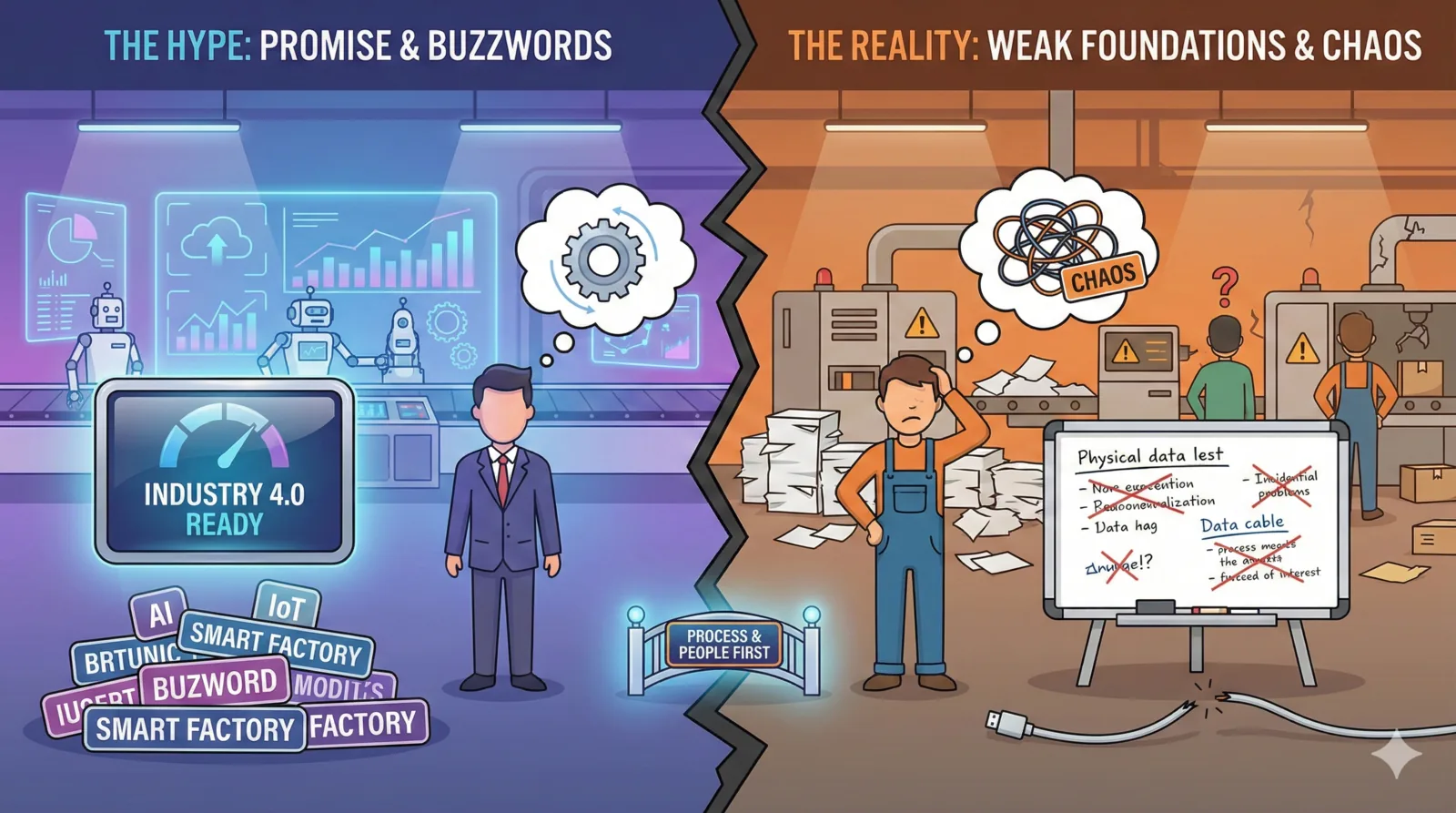
Digital factories are everywhere in presentations today.
Vendors show glossy dashboards.
Slides promise real-time visibility, “single source of truth,” and automatic planning.
Case studies talk about “smart factories” and “Industry 4.0 readiness.”
But if you walk through actual plants — including many woodworking and furniture factories in India — you often see something very different:
- Dashboards that don’t match reality.
- Operators still working with paper and WhatsApp.
- Machines idle while the screen shows “everything is fine.”
- Digital projects stuck in “pilot” mode for years.
It’s not that digital tools are useless. They can be powerful.
The problem is where and how we try to use them.
Digital transformation is not about dashboards or tracking software.
It’s about solving problems on the shopfloor.
Many projects quietly fail before they really start because companies forget a simple truth:
Technology is a tool, not the outcome.
Let’s unpack why these projects fail so early — and what you can do differently.
The Hype Trap: Buzzwords vs. Reality
“Digital factory,” “Industry 4.0,” “smart manufacturing,” “IoT,” “MES-lite”…
These phrases sound impressive, and they are easy to sell.
Typical story:
- Management sees a demo or attends a conference.
- They get excited about what’s possible.
- A project is launched: “We need to digitalize!”
- A tracking or monitoring system is purchased.
- Everyone expects things to improve automatically.
On the screen, the system looks perfect:
- Machine utilization in charts,
- Colour-coded progress bars,
- Live order statuses,
- Alerts and KPIs.
In the real factory, though:
- Material still arrives late to machines,
- Priorities keep changing during the day,
- People don’t fully trust the data,
- Planning continues on Excel, paper, and phone calls.
The mismatch between buzzword promises and ground reality is the first reason many digital factory projects never deliver meaningful impact.
Technology Is a Tool, Not the Outcome
Too many factories start their digital journey with a vague goal:
“We need Industry 4.0.”
“We should go paperless.”
“We must digitalize our factory.”
None of these are real goals. They are directions, not destinations.
Clear goals sound more like:
- “We want to reduce lead time by 20% for our top product family.”
- “We want to cut rescheduling and priority changes in half within six months.”
- “We want to reduce searching time for material and WIP by 50% on the shopfloor.”
- “We want more accurate promised dates to customers, based on real capacity.”
Only after defining outcomes like these should you ask:
“Where exactly can digital tools help us achieve this faster, easier, and more reliably?”
When technology becomes the starting point, projects drift into:
- Long configuration cycles,
- Endless debates about features,
- Fancy dashboards that are never used to make decisions.
When problems and outcomes are the starting point, technology becomes what it should be:
A lever, not the hero.
Dashboards vs. Reality: When Screens Lie
In one assessment, a factory owner proudly showed me a large dashboard in his office:
- Every CNC and saw had a status.
- There were graphs of utilization.
- Orders were color-coded by due date.
It looked like a textbook “digital factory.”
Then we walked to the shopfloor.
- Several machines were idle, waiting for material.
- Operators were asking supervisors what to run next.
- A few urgent orders were being tracked on a separate whiteboard.
- Rescheduling decisions were being made in quick hallway conversations — not in the system.
The dashboard did show data.
It just didn’t control behaviour.
That’s the key point:
- Dashboards show what is happening (or should be happening).
- They do not fix material flow, planning habits, training gaps, or unclear priorities.
If you don’t design how people will use the information — who acts on what, when, and how — then the screen becomes:
A digital painting of an ideal factory, hanging in the office, while the real factory continues as before.
Vendor Promises vs. Ground Reality
Another reason digital projects fail early: over-promising and over-buying.
Sales demos are designed to impress:
- Perfectly clean master data,
- Fully integrated processes,
- No missing entries,
- No “real-life noise.”
What’s rarely discussed in depth is:
- The effort needed to keep data clean,
- Who will maintain master data and how,
- What happens when operators skip or delay entries,
- How much configuration and adjustment is needed after go-live.
Before signing any digital factory contract, it’s worth asking very practical questions:
-
Fit to current reality
- How will this system work with the way my planners and supervisors actually make decisions today?
- What happens if some data arrives late or is incomplete?
-
Data entry expectations
- Who is expected to enter what, at which moment, using which device?
- What is the backup when the network or tablets are down?
-
Maintenance effort
- Who owns master data (products, routings, times, machines)?
- How many hours per week will it take to keep it healthy?
-
Start small vs. full-blown MES
- Can we begin with a narrow scope (one line, one product family)?
- What does a minimal, valuable first phase look like?
Many factories don’t start with a full-scale MES. They begin with “MES-like” solutions:
- Machine monitoring tools,
- Simple production tracking,
- Lightweight planning boards.
These are useful only when they are aligned with real needs and grounded expectations. If not, they join the list of “software we bought but don’t really use.”
Weak Foundations: Trying to Digitise Chaos
This is the single biggest reason most digital factory projects fail early:
Digitising a bad process does not fix the process.
It just makes the problems more visible and more painful.
Common patterns:
- Installing production tracking while material flow is still chaotic.
- Expecting dashboards to replace missing standards.
- Hoping software will solve layout and WIP issues.
- Adding more screens while people are still hunting for tools and parts.
Before you go digital, certain basics must already be in place:
1. Stable, repeatable processes
- Clear steps and handovers for each product family.
- Defined responsibilities at each station.
- Known “normal” cycle times (even if approximate).
2. Balanced workloads
- No permanent “hero” stations that always become bottlenecks.
- Incoming work roughly matched to realistic capacity.
3. Clean, consistent master data
- Products, routings, and times at least 70–80% reliable.
- A simple method to correct and improve data over time.
4. Visual management that works without a computer
- Whiteboards, tags, or simple visual cues on the floor.
- People already using them to see flow and status.
If a factory cannot run reasonably well with basic, low-tech visual management, adding digital layers will likely create more confusion, not less.
Digital tools should amplify a stable system, not try to rescue a broken one.
People and Adoption: The Most Overlooked Factor
Even when the tool is good and the process is designed well, projects fail for a human reason:
- Operators see the system as “extra work.”
- Supervisors fear being exposed by transparent data.
- Middle management worries about losing informal control.
So what happens?
- Data is entered at the end of the shift, from memory.
- Scans are done late or in batches just to “close orders.”
- People find shortcuts around the system whenever they’re under pressure.
On paper, the digital project is “live.”
In reality, it is bypassed.
Successful digital factory projects treat people as co-creators, not just “users.”
Practical steps:
- Involve key operators and supervisors in designing the new way of working.
- Run small pilots and genuinely listen to feedback.
- Make sure the system helps them in their daily job (less searching, fewer surprises, clearer priorities).
- Celebrate early wins (e.g. faster changeovers, fewer status calls) so people see benefits quickly.
A tool can guide behaviour.
Only people can change it.
A Practical Checklist Before Starting Any Digital Factory Project
To avoid the early failure trap, you can run through this simple checklist before committing serious budget.
1. Can you state the problem without mentioning technology?
Good:
- “Our on-time delivery is stuck at 70%; we want to reach 90%.”
- “Supervisors spend 2–3 hours a day just finding where jobs are.”
- “We reschedule major orders at least 5 times before dispatch.”
Weak:
- “We want live tracking.”
- “We need a dashboard.”
- “We should implement MES.”
If you can describe the problem in operational terms, you’re ready for the next step.
2. Are your core processes understood and at least somewhat stable?
- Do you have a reasonably clear map of how orders move through the factory?
- Do most people agree on the main bottlenecks today?
- Can you explain, on one page, how a typical job flows from order to dispatch?
If the answer is “no,” a process and flow exercise should come before any software decision.
3. Is there a minimum level of visual management already in place?
- Can a stranger walk your factory and roughly see what’s running where?
- Are priorities for today visible anywhere other than WhatsApp?
- Do supervisors have a simple, shared view of the plan?
If everything lives in heads and phones, digital tools will simply mirror the confusion.
4. Who will own data quality?
- Who maintains product and routing data?
- Who will validate times and update them when reality changes?
- Who ensures machines, shifts, and calendars are correctly set up?
If you don’t know yet, you’re not ready. Digital systems run on data the way machines run on power.
5. Do you have a small, realistic pilot in mind?
- One line, one area, or one product family.
- Clear success criteria: “If we see A, B, and C improve, we call this a success.”
- A defined time window and budget.
Pilots that are too broad usually drown in exceptions. Narrow pilots teach you how your organisation actually adopts change.
6. Is there a real sponsor on the factory side?
- One person who cares deeply about the outcome,
- Has enough authority to remove obstacles,
- And is willing to walk the floor, not just attend review meetings.
Without this, projects drift and slowly lose energy.
What Successful Digital Factory Projects Have in Common
Across different industries and geographies (including many Indian factories), the digital initiatives that actually deliver tend to share a few traits:
-
Operations-led, not IT-led
Technology teams are key partners, but the driving questions come from operations: flow, capacity, reliability, lead time. -
Problem-first, tool-second
The team spends more time defining problems and scenarios than reviewing features. -
Small, fast iterations
Start with something simple that genuinely helps people this month, not a giant “version 1.0” in 18 months. -
Continuous learning
Assumptions about data, behaviour, and processes are challenged and updated as the system goes live.
You can see this pattern in the digital and factory projects summarised on my resume page — the biggest wins rarely come from the flashiest tool. They come from tight alignment between process, people, and technology.
Final Thought: Start with the Factory, Not the “Digital”
Digitalization is powerful. Dashboards, tracking systems, and monitoring tools can transform how a factory runs when the foundations are ready.
But they are not magic.
Factories don’t become great because they installed digital tools.
They become great because their processes, people, and flow are aligned — and technology amplifies that alignment.
So the next time you’re excited about a digital factory project, pause and ask:
- Are we trying to fix chaos with software?
- Or are we using software to support a direction we already understand?
If you choose the second path, your project won’t fail before it starts.
It will become one more step in building a factory that is genuinely smarter — not just more digital.
Comments (0)
Loading comments...
Leave a Comment