
In the woodworking and furniture manufacturing industry, every big equipment decision carries a lot of hope.
More output.
Fewer errors.
Better finish.
Smoother processes.
So it’s frustrating when, months after installing a new CNC, beam saw, or edge bander, you find yourself asking:
“Why hasn’t this new machine delivered the improvement we hoped for?”
Most of the time, the machine is not the real problem.
The gap is in how well that machine fits into your overall system – your workflow, layout, people, software, and business goals.
That’s where one subtle but important distinction becomes critical:
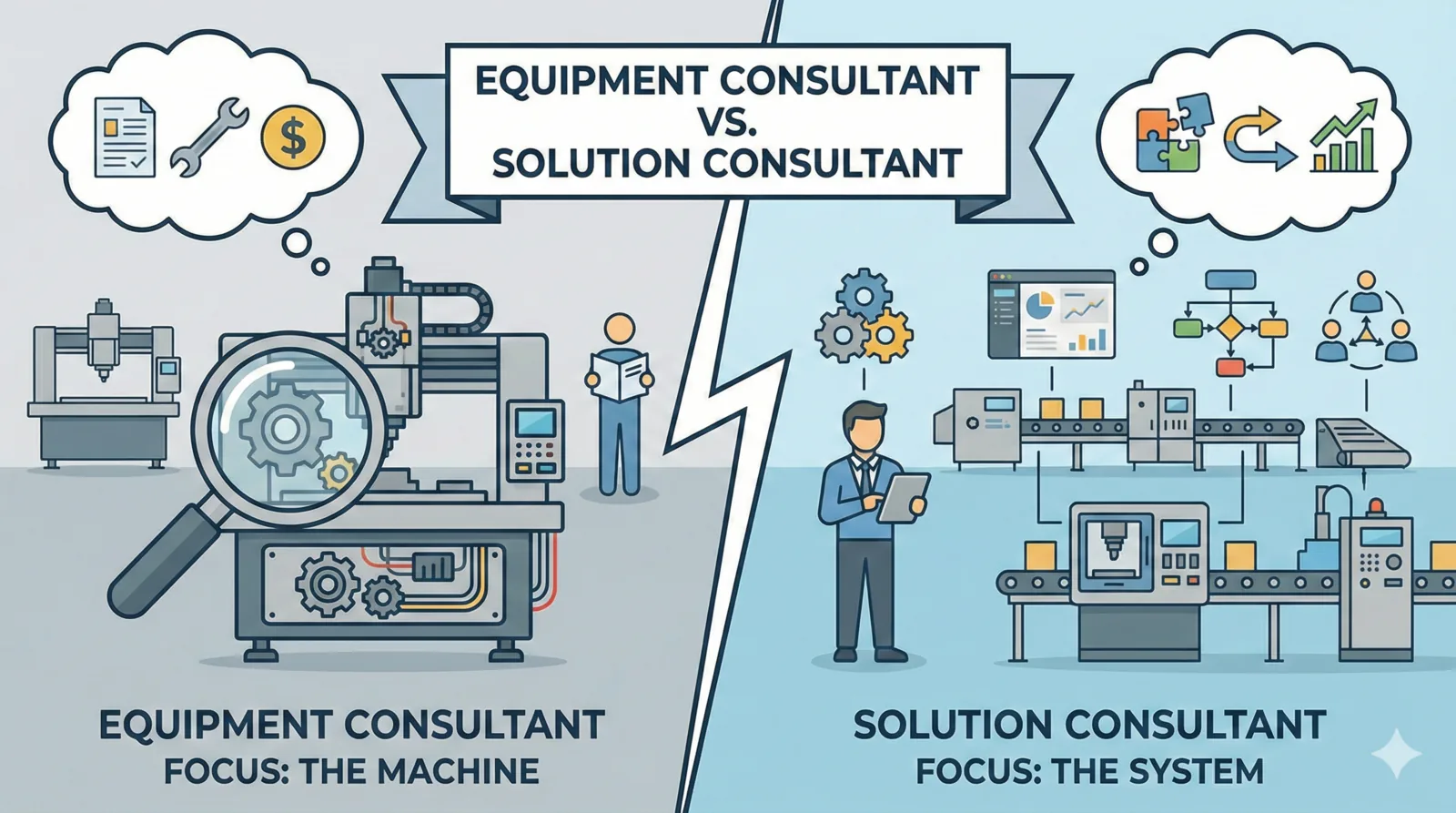
Are you working with an Equipment Consultant – or a Solution Consultant?
Understanding the difference can easily mean the difference between:
- A shiny new machine that becomes an expensive island, and
- A carefully chosen solution that lifts the performance of your whole factory.
What Does an Equipment Consultant Really Do?
An Equipment Consultant focuses on helping you choose and configure the right machine.
They are the specialists you go to when you know what process you want to automate or upgrade, and you now need the best tool for that job.
Typically, an equipment consultant will look at:
-
Your technical requirements
(workpiece sizes, tolerances, tooling, edge profiles, finishes) -
Your production volumes
(how many sheets, how many jobs per shift, per day, per month) -
Your materials
(MDF, particle board, plywood, HDF, laminates, veneers) -
Your available space and utilities
(footprint, dust extraction, power, compressed air) -
Your budget range
They know machines inside-out:
- CNC routers and nesting machines
- Beam saws and panel saws
- Edge banders
- Through-feed drills and point-to-point machines
- Sanding and finishing lines
Their strength is product knowledge. They can compare models and brands and guide you to the machine that best fits your stated requirement.
If your question is, “We need to upgrade this specific process, which machine makes the most sense?” – an equipment consultant is absolutely the right person to talk to.
But what if you’re not fully sure whether a new machine is the real answer at all?
What Does a Solution Consultant Do?
A Solution Consultant starts from a different place.
Instead of asking, “Which machine do you want?”, they step back and ask:
“What problem are you trying to solve – and what’s the best way to solve it?”
They look at the whole system, not just a single piece of equipment.
Typical focus areas:
-
Workflow design and process improvement
How does work move from design to cutting, edging, drilling, assembly, and dispatch? -
Factory layout and material flow
Are machines placed in a way that supports flow, or in the order they were purchased? -
Software and machine integration
How do CAD, CAM, nesting, ERP, and production tracking tools connect with your machines? -
Information flow and decision-making
Where do orders get stuck? Who decides priorities? How clear are instructions to the shop floor? -
ROI-based planning
Does a new machine genuinely improve throughput, lead time, quality, or margin – or just feel like progress?
In short:
-
An equipment consultant asks:
“Which machine do you need?”
-
A solution consultant asks:
“What outcome do you want – and what is the smartest combination of process, people, layout, software, and equipment to get there?”
Both roles are valuable. The key is knowing which one you actually need for the decision in front of you.
Not Every Problem Needs a New Machine
One of the most common patterns I see in furniture factories – especially across Indian hubs like Delhi-NCR, Bengaluru, Pune and similar clusters – is this:
The factory hits capacity or quality issues, and the first instinct is:
“We must buy another machine.”
Sometimes that’s true. Often it isn’t.
Let’s revisit a real kind of situation, simplified but very common.
The “We Need a Second Beam Saw” Story
A mid-sized furniture manufacturer reaches out and says:
“We’re not meeting output targets. Our beam saw is overloaded. We think we need a second one.”
On the surface, the logic is simple:
- One saw is not enough → add another saw → problem solved.
Instead of jumping straight to a machine quotation, a solution-focused conversation starts with observation:
- Spend a few hours on the shop floor.
- Watch how orders arrive and are prioritised.
- See how the operator actually uses the beam saw.
- Trace how cutting plans are created and transferred.
In one such case, this is what emerged:
- The saw operator was receiving only a basic part list – no optimised cutting plans.
- They spent more than 50% of their time manually figuring out cutting patterns on the shop floor.
- While this planning happened, the machine was idle.
- Meanwhile, the factory believed the saw was “running at full capacity”.
The recommendation was surprisingly simple:
- Use the cutting optimisation software that already came with the machine.
- Generate optimised cutting plans in advance.
- Send ready-to-execute programs to the saw, so the operator focuses on running the machine, not on manual planning.
Result:
- Idle time dropped sharply.
- Output increased significantly – without adding a second saw.
- The same machine, once blamed as “too slow”, was now comfortably meeting demand.
No new investment.
No extra operator.
Just better coordination between software, people, and process.
This is a classic example of where:
- An equipment consultant might have helped you choose a great second saw.
- A solution consultant helped you discover you didn’t actually need one.
Why Paying for Consulting Feels Risky
It’s natural for business owners and factory leaders to think:
“Why should I pay a consultant?
Isn’t that money better spent on a machine, tool, or something tangible?”
On a quotation, consulting looks like a cost with no hardware attached.
But consider the other side:
- Buying a machine without the right guidance can easily lock you into years of underutilisation.
- A machine might never run at full potential because it was:
- Installed in the wrong spot,
- Poorly integrated into the workflow,
- Mismatched with upstream or downstream processes,
- Chosen to fix a symptom, not the real root cause.
In those cases, the real “expensive” decision was not the consultant’s fee, but the wrong or premature equipment purchase.
A good solution consultant helps you:
- Avoid over-investing or under-investing,
- Be clear about the problem you’re solving,
- Choose equipment only when the system is ready to support it.
Think of it this way:
Equipment consultants help you buy the right machine.
Solution consultants help you make sure you’re buying for the right reason.
How Equipment and Solution Consultants Can Work Together
This is not an “either/or” fight.
The best outcomes usually come when both types of experts are involved at the right time.
A simple sequence that works well in woodworking and furniture factories:
Step 1 – Solution consulting: clarify the real need
- Understand your product mix, order patterns, and growth plans.
- Map your current flow and identify true bottlenecks.
- Decide what has to change first: layout, information flow, skills, software, or equipment.
- Define clear performance targets:
- Lead time,
- Throughput,
- OEE,
- Quality,
- Margin.
Step 2 – Equipment consulting: select the right machine
Once the system-level needs are clear:
-
The solution consultant outlines what type of equipment is needed (if at all):
- Capacity range,
- Level of automation,
- Integration needs,
- Space and utility constraints.
-
The equipment consultant then:
- Compares brands and models,
- Validates technical fit,
- Helps with demos and trials,
- Guides you on options and configurations.
Step 3 – Joint implementation
When both work together, you get:
- A machine that fits the technical requirements,
- Installed in a layout that supports flow,
- Integrated properly with software and information,
- Backed by new habits and standards on the shop floor.
This coordinated approach avoids:
- Under-dimensioned machines that become bottlenecks,
- Over-sized machines that never pay back their cost,
- “Islands of automation” surrounded by chaos.
When Do You Need Which Expert?
A practical way to decide:
Call an Equipment Consultant when:
-
You have a well-understood, localised problem:
e.g. “Our current edge bander cannot handle this new edge profile.” -
You already have:
- A stable process,
- A clear layout,
- Reasonable planning,
- And you’re not trying to change the whole system.
-
Your main question is:
“Which model, brand, or configuration is best for this process?”
Call a Solution Consultant when:
-
You see recurring system-level issues:
- Chronic delays and firefighting,
- High WIP,
- Frequent rescheduling,
- Conflicts between sales, design, and production.
-
You are considering big investments:
- New lines,
- New plant,
- Significant automation upgrades.
-
You feel symptoms like:
- “Everyone is busy, but output isn’t growing.”
- “We add machines and still face bottlenecks.”
- “Each season, chaos returns despite our best efforts.”
-
Your real question is:
“What is the smartest next step for our factory’s growth?”
In many of the line optimisation and factory planning projects I’ve been involved in, the first task is simply helping the owner or leadership team frame the question correctly.
Once that happens, equipment decisions become much clearer and far less risky.
A Simple Checklist Before Your Next Big Equipment Decision
Before you sign a purchase order for your next machine, pause and run through this quick checklist:
-
Have we mapped our current flow?
- Order → design → cutting → edging → drilling → assembly → dispatch.
- Do we know where work really waits?
-
Are we already using existing machines close to their real potential?
- Are nesting, optimisation, or reporting tools used fully?
- Are programs standardised and reused?
- Is downtime mostly due to breakdowns or process issues?
-
Is our layout supporting or fighting our flow?
- Do panels travel back and forth?
- Are we frequently crossing paths and congesting aisles?
-
Do our software tools talk properly to our machines?
- CAD/CAM, nesting, ERP, and production tracking – are they integrated or manually bridged with Excel and WhatsApp?
-
Are we solving a root cause or a symptom?
- Is the “bottleneck” actually a machine… or a planning habit, data issue, or approval loop?
-
Have we spoken to both types of experts?
- A solution consultant to validate the system view.
- An equipment consultant to validate the machine choice once the need is clear.
If you can answer “yes” to most of these, your equipment investment is far more likely to deliver the gains you expect.
My Role as a Solution Consultant in the Woodworking Space
In my own work with woodworking and furniture factories – much of which is reflected on my resume page – my role is not to say:
“Buy this brand” or “Choose that model.”
Instead, my primary responsibility is to help you answer:
“What is the smartest next step for your factory’s performance and growth?”
That step might be:
- Rethinking the layout around real product families,
- Fixing information flow between sales, design, and production,
- Connecting software and machines so people stop re-entering data,
- Clarifying roles and responsibilities to reduce firefighting,
- Or, yes, recommending a specific type of machine – once we are sure it is the right lever.
The goal is always the same:
Stronger systems, not just stronger tools.
Final Thoughts: Don’t Just Buy Machines. Build a System.
Before your next investment, try changing the question:
Instead of:
“Which machine should we buy?”
Ask:
“Do we need a machine – or do we need a better system?”
If you’re solving a focused, technical need with a clear scope, an Equipment Consultant is the right expert.
If you are chasing higher performance, better coordination, or a future-ready operation, a Solution Consultant can help you:
- Clarify the real problem,
- Design a system-level improvement path,
- And then bring in the right equipment at the right time.
And when both types of consultants work together –
That’s when equipment decisions turn into true competitive advantage, not just more metal on the shop floor.
Comments (0)
Loading comments...
Leave a Comment