
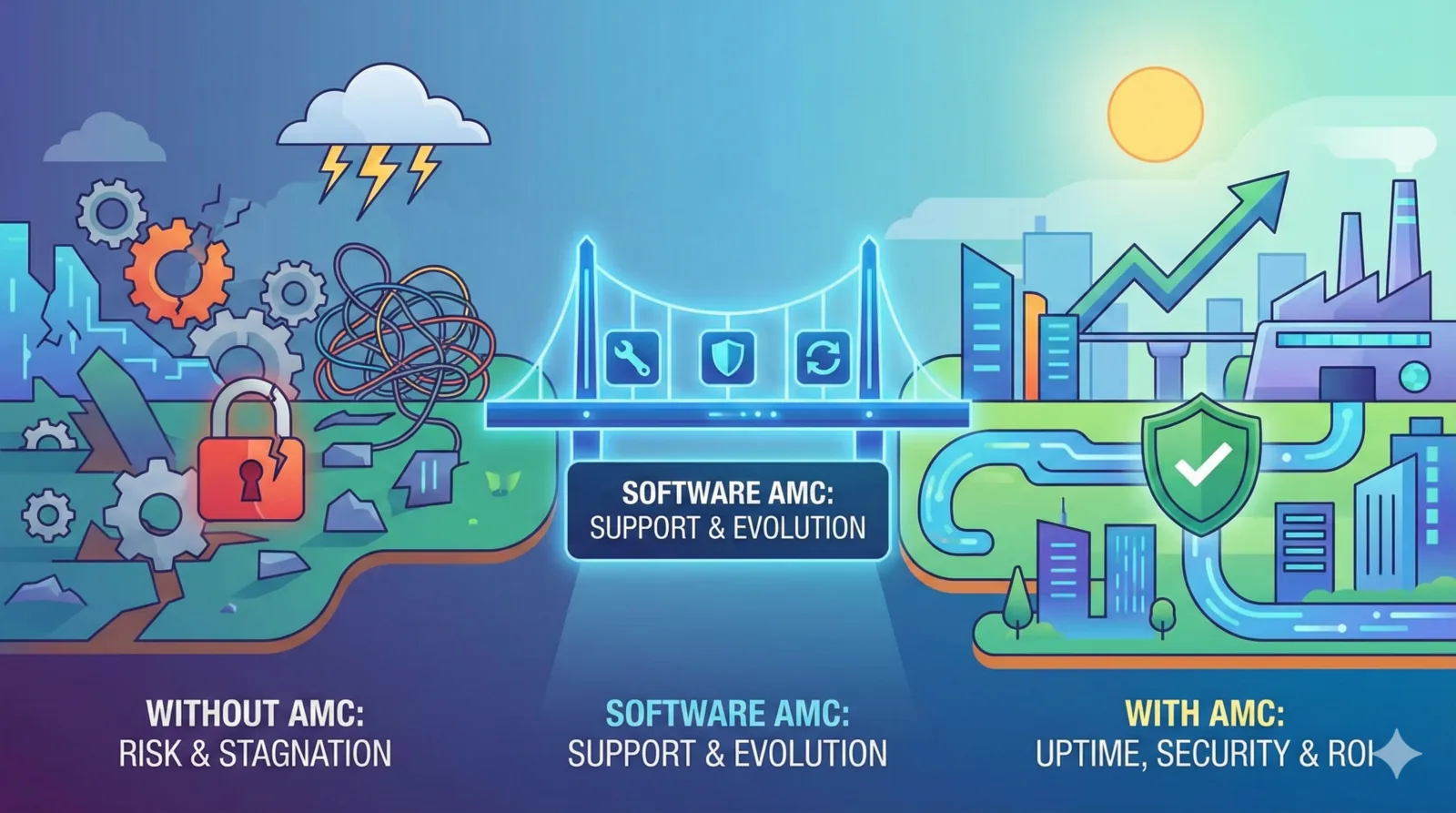
In almost every modern business, software quietly runs the show.
It plans production, tracks orders, controls machines, manages inventory, and stores years of customer relationships. Yet once the software is installed and the first project is live, many companies treat it as a one-time purchase rather than a living system.
That’s where a Software Annual Maintenance Contract (AMC) comes in.
On a quotation, an AMC can look like an extra, optional cost. Many owners and managers ask:
“The software is already working. Do we really need to keep paying every year?”
On the surface, it feels like a place to save money. But if you look at how software behaves over three, five, or ten years, the story changes completely.
In this article, we’ll break down what a Software AMC really is, what you should expect from it, and how it protects your uptime, security, and long-term return on investment—especially for factories and businesses in India that rely on software to run their daily operations.
What Is a Software AMC, Really?
A Software AMC is a service agreement with your software provider that guarantees ongoing care for your system after go-live.
Instead of thinking of it as “paying again for the same thing”, think of it as:
A health plan for your software – covering updates, fixes, support, and improvements that keep it useful and safe as the world changes around it.
A well-structured AMC typically covers several pillars.
1. Continuous support when things go wrong
No matter how well software is designed, real usage will always throw surprises:
- A new team member clicks something unexpected and breaks a configuration.
- A machine stops receiving data from the software.
- Reports don’t match because of a small setup change.
- Integration with another system behaves differently after their update.
With an AMC, you are not alone in those moments. You have:
- A defined support channel (ticket, email, phone, portal).
- Defined response times.
- Access to people who know the system at depth and can guide your team.
This is not “nice-to-have”. In many factories, every hour of downtime costs far more than the annual AMC fee.
2. Regular patch updates and bug fixes
Software lives in a moving environment:
- Operating systems update.
- Databases change.
- Security threats evolve.
- Hardware gets replaced.
Each of these shifts can subtly break things or open security holes.
Within an AMC, your provider releases patches and hotfixes that:
- Close known vulnerabilities.
- Fix discovered bugs.
- Maintain compatibility with newer OS or database versions.
Without these, you gradually move from “stable” to “fragile”: things still work, but every change in surrounding systems becomes risky.
3. Version upgrades and new features
Most modern software is not frozen. The vendor continuously develops:
- New features,
- Better workflows,
- Improved reports and dashboards,
- Performance optimisations.
With a good AMC, you usually gain access to major and minor version upgrades without buying the software again. This means you can:
- Benefit from years of R&D,
- Stay compatible with new industry requirements,
- Offer better tools to your own team and customers.
For example, a planning or nesting software used in a woodworking factory in India might introduce:
- Faster algorithms that reduce computing time,
- Better material optimisation to save board costs,
- Deeper integration hooks for machines or ERP.
Over a few years, these improvements add up to real money saved.
4. Customisation, enhancements, and small changes
As your business evolves, your software must follow:
- New product lines,
- Revised approval flows,
- Updated tax rules,
- Changed reporting needs.
An AMC often includes a framework to handle:
- Small change requests,
- Minor customisations,
- Adjustments in reports and forms.
You are not stuck with how the software looked on day one; it can grow with your business.
5. Training, handover, and documentation
People change roles. New team members join. Old ones move on.
Without a structured way to train them, your system becomes:
- Hard to use correctly,
- Dependent on one “expert”,
- Vulnerable when that person is absent.
A mature AMC usually includes:
- Periodic training sessions,
- Documentation and guides for key processes,
- Webinars or knowledge-base access.
This turns your software from a “black box” into a tool more of your team can use confidently.
Why a Software AMC Is Good for Your Business
From a distance, an AMC looks like a line item in the budget. Up close, it acts as a stability engine for your operations.
Here are some concrete ways it adds value.
1. Uptime and continuity: keep your operations moving
Every business has stories like:
- “The system stopped on the last day of the month, and we couldn’t invoice.”
- “Production halted because planning couldn’t release the next batch.”
- “We wasted a full shift because a configuration got corrupted.”
With reliable AMC support:
- Issues are diagnosed faster,
- Root causes are addressed, not just symptoms,
- Emergency workarounds are fewer and shorter.
Especially in Indian factories, where customer timelines are tight and penalties are real, avoiding even one major disruption can pay for the AMC several times over.
2. Security and compliance: protect your data and reputation
Threats to software are not theoretical anymore:
- Ransomware,
- Data breaches,
- Misuse of access rights,
- Accidental exposure of sensitive files.
Your software vendor tracks vulnerabilities and evolves security measures. Under an AMC, you receive:
- Security patches,
- Access control improvements,
- Recommendations on hardening your environment.
For businesses handling design IP, customer data, or financial information, this is not about fear. It’s about responsible risk management.
3. Performance and user experience: avoid slow decline
Software rarely fails overnight. More often, performance decays slowly:
- Screens take longer to load,
- Reports time out,
- Users find “workarounds” outside the system.
An AMC allows for:
- Performance tuning,
- Database housekeeping,
- House-cleaning of unused features and data.
The result is a system that still feels fast and supportive years after implementation, instead of something people complain about daily.
4. Better ROI on your original investment
You already invested in:
- Licences,
- Implementation services,
- Internal manpower,
- Change management.
Without ongoing maintenance, part of that investment will decay:
- Features remain unused,
- Integrations break,
- Processes slip back into Excel and WhatsApp.
With an AMC, you protect and extend the life of that investment. New features and improvements increase the value, and good support keeps adoption high.
What Happens When You Skip the AMC
Choosing not to sign or renew a Software AMC doesn’t show consequences on day one. Things still run. But gradually, certain patterns appear.
1. Longer, more painful downtimes
Without guaranteed support:
- You rely on internal trial-and-error,
- You wait for “favour” support or pay high emergency rates,
- Problems drag on, affecting multiple departments.
In some cases, vendors may not even be able to help quickly because your version is too old or unsupported.
2. Growing security risks
As years pass without patches and updates:
- Your system runs on outdated components,
- Known vulnerabilities remain open,
- New compliance requirements (for data, audits, etc.) go unmet.
You may not notice anything until an incident happens. At that point, the cost and stress are often much higher than years of AMC would have been.
3. Outdated functionality and lost opportunities
While you stand still, your competitors move forward:
- They adopt features that give them better planning visibility,
- They integrate more deeply with customers and suppliers,
- They gain insights from dashboards you don’t have.
The risk is not only technical. It is strategic: you gradually lose edge because your tools no longer match market speed.
4. Higher ad-hoc costs and project shock
Many companies think:
“If something breaks, we’ll just call the vendor and pay for a one-time fix.”
The reality:
- Ad-hoc rates are often significantly higher,
- You may have to pay for an upgrade first before support is even possible,
- Lead times are longer because contract customers get priority.
So instead of one predictable annual fee, you get random, heavy bills at the worst possible times.
A Simple Way to Think About AMC ROI
Let’s simplify the math.
Assume:
- Your software is core to operations (planning, production, sales, or finance).
- A day of serious disruption costs your business ₹2–5 lakh in lost output, penalties, overtime, and stress.
- A year of AMC costs significantly less than that.
If an AMC helps you avoid just one such incident, or reduce its impact from a full day to a few hours, it has likely paid for itself.
On top of that, add:
- Material savings from better optimisation in upgraded versions,
- Time saved by improved workflows,
- Fewer manual Excel “patches” around the system.
The purely financial case for a good AMC is usually stronger than it looks at first glance.
How to Get the Most Out of Your Software AMC
Not all AMCs are equal. To maximise value, treat your AMC as a partnership, not just an invoice.
1. Clarify what is included
Have a clear, written understanding of:
- Support channels and timings,
- Response and resolution targets,
- What counts as included support vs. paid enhancement,
- Policy for bug fixes vs. change requests,
- Frequency and type of updates and upgrades.
This avoids frustration later and sets shared expectations.
2. Use the support you are paying for
Many companies underuse their AMC:
- Issues are solved informally inside the team,
- People live with small problems instead of raising tickets,
- Training sessions offered by the vendor are rarely attended.
As a result, the system drifts away from best practice.
Encourage your team to:
- Log issues properly,
- Attend periodic training or refresher sessions,
- Ask “can the system do this for us?” before building yet another Excel file.
3. Plan upgrades instead of reacting
Agree on an upgrade rhythm with your vendor:
- Minor version updates every year or so,
- Major upgrades every few years, with proper testing.
Schedule these during lower-load periods. This way, upgrades become routine improvements instead of emergency surgery.
4. Combine AMC with internal ownership
An AMC is not a substitute for internal responsibility.
Nominate:
- A system owner or key user for each area,
- A small cross-functional group that meets periodically with the vendor.
Use these forums to:
- Review recurring issues,
- Plan upcoming improvements,
- Align the software roadmap with your business roadmap.
This is where AMC support turns into continuous improvement, not just problem-fixing.
When Does It Make Sense to Question or Adjust AMC?
There are cases where it is reasonable to review your AMC setup.
For example:
- The software is genuinely no longer strategic for your business.
- You are planning to replace it within a short timeframe.
- The AMC contract has grown in cost without clear added value.
In such situations:
- Discuss options with your vendor: reduced scope, shorter terms, or transitional support.
- Avoid a hard cut that leaves you unsupported while still dependent on the system.
- Make sure you have a clear migration plan if you are moving away.
The goal is not to keep paying blindly, but to align AMC with the real role of the software in your operations.
Bringing It All Together
In today’s digital operations — whether in manufacturing, services, or multi-location businesses in India — software is as critical as machines and people. You would not run a factory without maintaining your equipment. Likewise, running critical software without an AMC is a quiet gamble.
A Software Annual Maintenance Contract is not just an extra on top of the licence:
- It is your assurance of support when things go wrong.
- It is your pathway to continuous improvement as new features and optimisations are released.
- It is your shield against security and compatibility risks that grow over time.
- It is your way to protect the ROI of the original investment in licenses, implementation, and change.
The question is not, “Can we avoid paying for an AMC this year?”
A better question is:
“Which risks and missed opportunities are we willing to accept if we don’t?”
For many businesses, the honest answer is: very few.
If your factory or organisation relies on specialised software for planning, production, or integration with machines and customers, it may be worth revisiting how you manage AMCs as part of your broader digital strategy. In my work across factories and tools – examples of which are reflected on my resume page – I’ve seen that companies who treat their software as a living asset, supported by a strong AMC, build far more stable and scalable operations over time.
Comments (0)
Loading comments...
Leave a Comment